Critical Corner: Abilitopia and White Noise
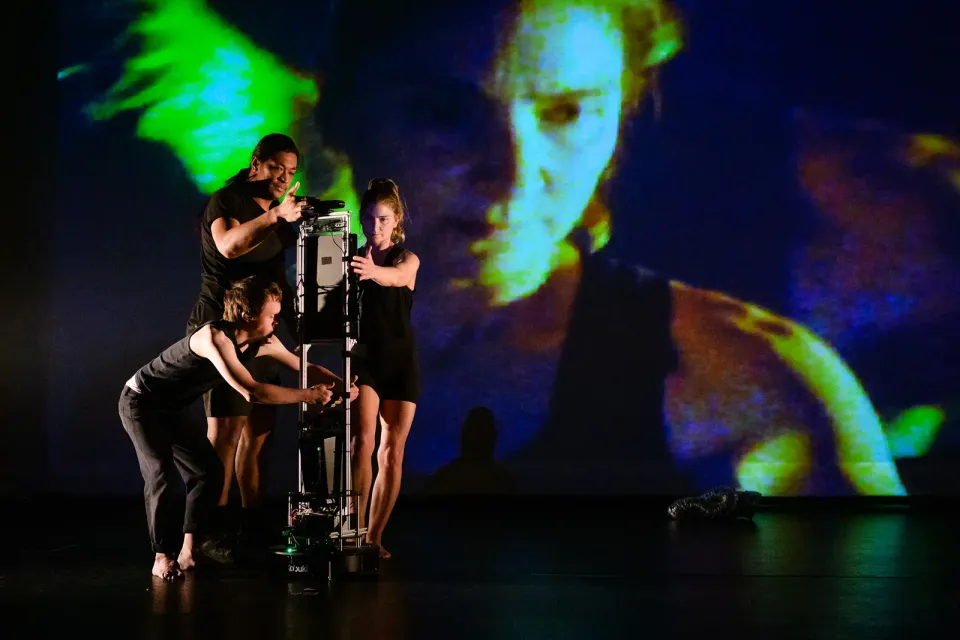
In this edition of Critical Corner, reviews of two new dance shows from New Zealand’s leading disability-led arts organisation Touch Compass.
I need to say something up front: I am a complete AI agnostic. My belief is that it is a true fad that is being pushed on the world by people whose financial interests are in AI succeeding, and that much of what could be “good” or “progressive” about AI pales in comparison to every other issue with it. This is a reheated joke, but I’ve found that the best use of AI is that someone bringing it up in conversation is a great indication of when to walk away from them.
That being said, I went into Abilitopia, a philosophical interrogation of the ways in which AI can tear down barriers for access and create pathways for participation with a much more open mind. So little of the conversation about AI has been around ways to create pathways for access for people, be it access to methods of communication, participation or the act of creation itself, that even the skeptic and the cynic in me was convinced to open and engage.
Abilitopia rewarded my curiosity. It’s a magnificent show, directed by Suzanne Cowan, and devised and performed by Duncan Armstrong, Raven Afoa-Purcell and Julie Van Renen. The trio are joined by a robot onstage, unnervingly personified with a screen where a small human’s face would be, with one massive eye blinking at us while narration talks to us (I couldn’t tell whether the narration was AI-performed or generated, which doesn’t make it any less unnerving). As expected from a Touch Compass show, the design is also excellent, with Rachel Marlow on lights and AV, Kristian Larsen on sound, and Adam Ben-Dror on robot design. It’s a credit to the show when I say that it is led by neither performers nor design nor even philosophy, but all three are constantly in conversation with each other; cohesive without feeling uniform or one-note.
The piece moves through several movements, with the performers acting in concert with each other and the robot. At times, the robot exists as extension of the performers, in others as a performer in its own right. These movements don’t treat AI as a theoretical, something that exists in the future, but as something that disabled people are using in their lives already, and what a world might look like if that community could be able to co-author what the integration of this tech looks like. It’s a question that I’ve never asked myself, and as I sit to write this review a few days later, I still don’t know where I sit on it. I’m also not sure if it’s my place to have an answer for it.
Another part that sticks with me are the final parts of the show, where photos are taken of the audience by the robot. These photos are refracted and distorted with the use of AI. Eventually, cephalopods (my amateur eye couldn’t determine if they were octopi or squids, or somewhere in between) make their way into the image, multiplying and distorting it even further. These parts have also left me feeling unnerved, but not incurious, although perhaps my mind wandered into places not intended by the creators. We’re so used to treating images, photographs in particular, as the determinator of undisputed authenticity. What happens when that information is no longer guaranteed? Again, I don’t know, but I valued that Abilitopia was able to throw so many questions at me without feeling like it needed me to answer them in the moment, but just sit with them and consider them. Thankfully, I can do that while also sitting in admiration of the artistry that leads to being able to pose these questions so thoughtfully, and so eloquently, with performance in the first place.
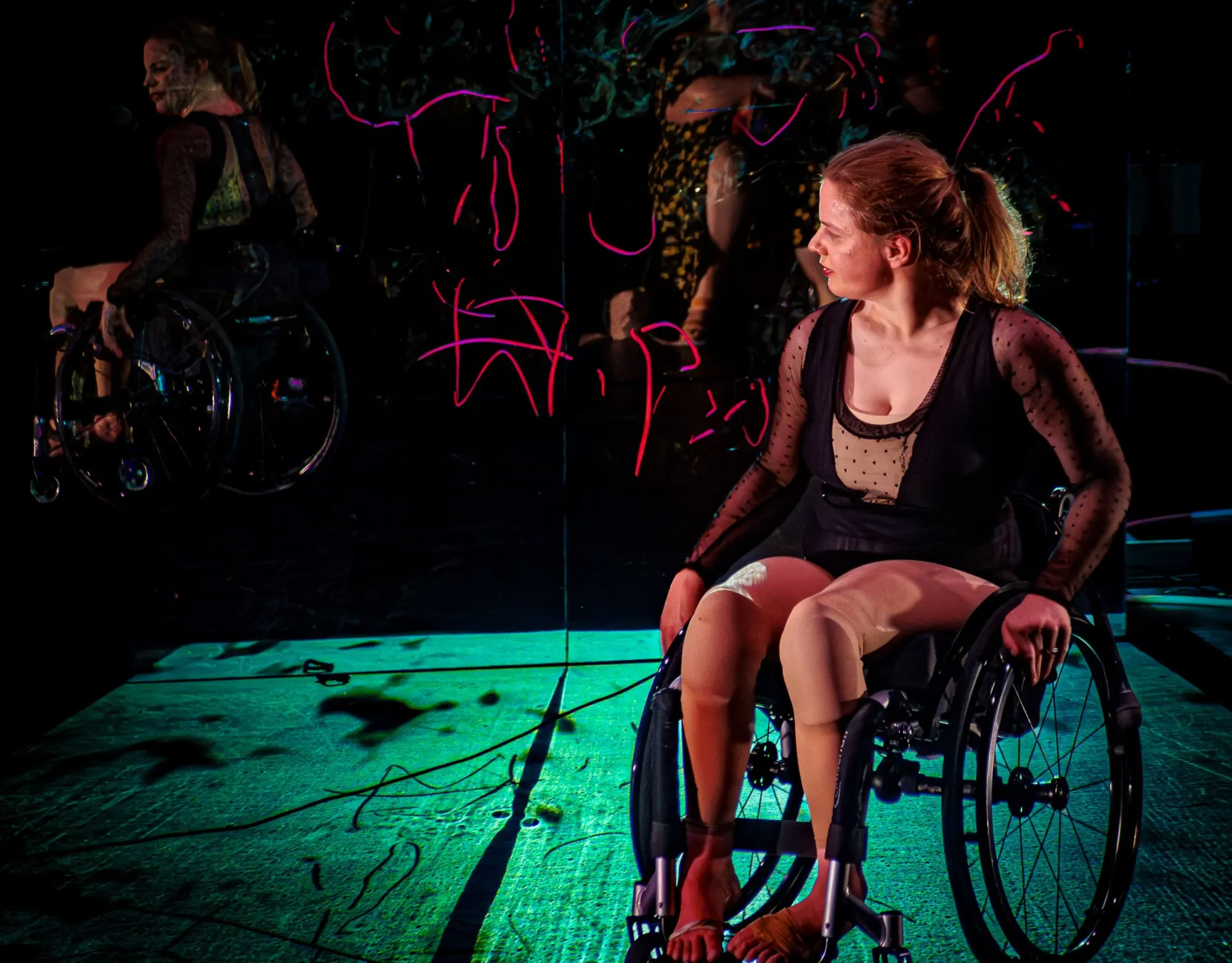
The other part of Touch Compass’ double bill was White Noise, a choreographic collaboration between Alisha (McLennan Marler, but referred to mononymously) and Jessie McCall, reflecting on preconceptions around motherhood and redirecting the lens back onto the observer. It’s a work that is immediately confronting, turning the lights on the audience almost immediately, but that confrontation immediately settles into a communal air. An invitation, rather than an admonishment.
White Noise is a fleet, immediate, piece of work. Alisha moves throughout the space playfully, creating music with her wheelchair (the score is designed by Drew McMillan) and other elements onstage, most memorably a hammock. To perhaps state the obvious, it leads to an undeniably present piece of work, which is also aided by the digital design provided by Brad Gledhill. Although Alisha is the only performer onstage, she creates and participates in her own feedback loops. And look, I’m not a parent, let alone a mother, but being invited into the physical expression of what I’m culturally aware of as being a quite isolating time is a privilege.
Another thing that I appreciated about White Noise is that it is an undeniably loud show. Conventional microphone technique is not so much abandoned as it is entirely ignored to create the kind of noises that might be considered unpleasant onstage, but, hey, unpleasant noises are part of life, so they’re undoubtedly part of motherhood. Despite this loudness, the moments that have lingered with me are the most quiet, Alisha communicating with a digital manifestation of her child, and leaving us with a sentiment (which I won’t spoil) that every human, regardless of parenthood or childhood, has felt when interacting with some other human at some point. Another triumph from the Touch Compass team.
Abilitopia and White Noise played at Te Pou Theatre from February 26 through to February 28.
Other Things I’ve Consumed
Been a while since I’ve done this bit, sorry! But I’ll write up a few things I’ve really enjoyed:
- The Everlasting by Alix E. Harrow is a book that I wasn’t expecting to enjoy based on the premise – a alternate history fantasy set in a vaguely British location, involving time travel of some sort. However, Harrow’s writing absolutely won me over (especially her creative use of tense) and I was happy that her use of time travel wasn’t a gimmick, but actually a way to interrogate her theme. Wild concept!
- The Pitt is A-grade television. I binged the first season earlier this year in about two days (no regrets, except not getting to it earlier) and I’m catching up with season two as it airs. Some of the best performances on TV (Katherine LaNasa!) and ace writing. Is it sometimes leaning on being educational? Absolutely, but some people need to learn.
- I’m slowly making my way through Industry. I love the work bits, I hate the bits that are essentially Skins. All the performers are doing good jobs!
Other Things to Read:
- Madeleine Chapman’s profile of Grishma, the best eyebrow threader in Wellington (and probably New Zealand) for The Spinoff is a masterclass of the form. Immensely enjoyable.
- The headline doesn’t say it all, but it’s a good start for this piece over at The Atavist: How a Small Welsh Town Tried to Save a Popular Sea Shanty Band
Writing and reporting takes time, and if you want to support the amount of time it takes (and ensure that the scant amount of meaningful coverage of local art can continue), please considering supporting Dramatic Pause with a paid subscription ($8 p/m, $60 p/a) and if you can't afford a paid subscription, please share the work with your networks!

Member discussion