Critical Corner: ANITO

In this edition of Critical Corner a review of Justin Talplacido Shoulder and the Future Folklore Collective’s show ANITO.
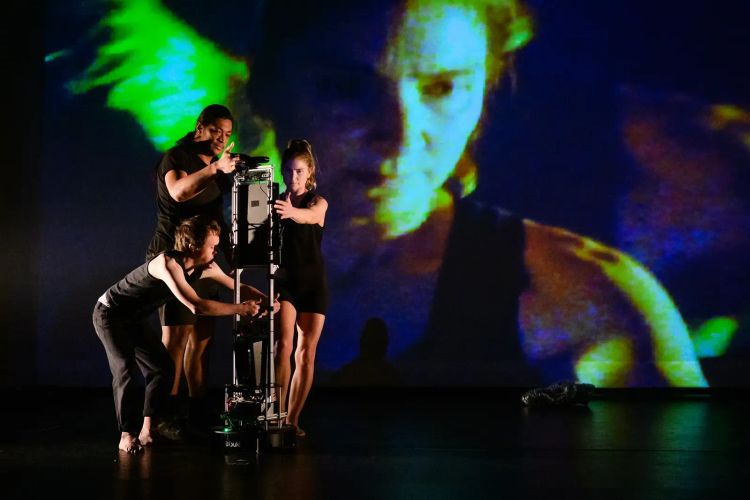
In one movement of ANITO, two dinosaur-like creatures create themselves, evolve, and eventually fuse together. In another, a witch-goddess creature covered in lace moves amongst mushrooms, performing some kind of ritual. In the final movement, the mushrooms turn into clown-esque phalluses, birthing and then consuming another figure.
That’s my read on the show, which comes to Tāmaki Makaurau from Gadigal Country, at least. It’s not exactly a show that lends itself to concrete descriptions or definitive interpretations. The show takes its name from Anitos, spiritual life forces that iinhabit all entities, animate and inanimate. ANITO’s copy describes the show as “[a combination] of collective craft, puppetry, dance and experimental music” and “a future folkloric world that conjures parallel possibilities and reimagines Filipino mythologies”. After seeing the show, I’m struggling with even these loose definitions, as it seems to be caging the show into a lens that it defies.
Performers Justin Talplacido Shoulder (also credited as director, production designer and costume designer and co-conceiver), Wikitoria Hunt (also credited as mentor and outside (inside) eye) and Eugene choi (also credited as co-generator) morph and transform into various figures throughout ANITO. All three are remarkably impressive performers, and puppeteers, and are well supported by the design around them. The opening images, where shafts of light pierce the projection, is just the first of a cavalcade of stark, vivid, imagery.
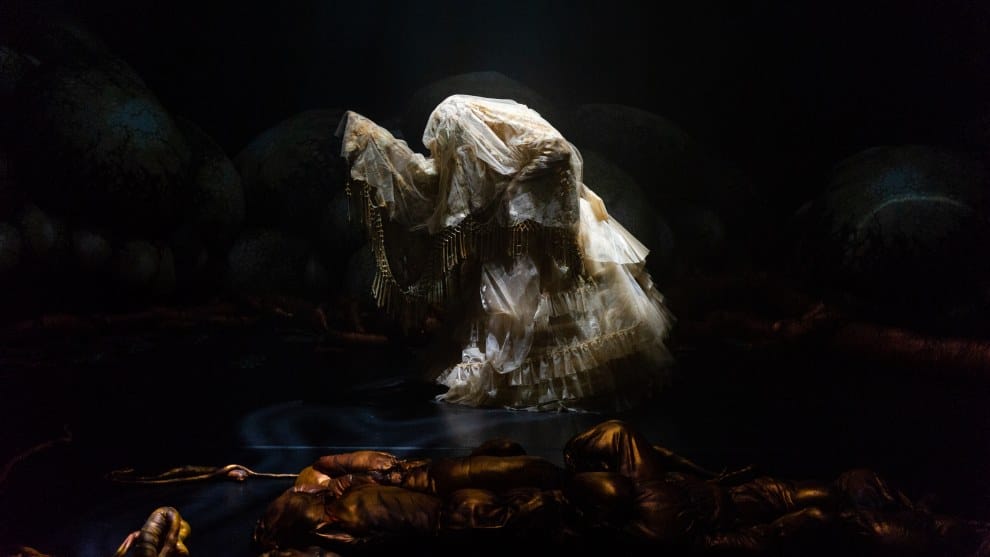
Frankly, it’s out-and-out spectacle. The imagery made me recall, if not with fondness then definitely in a positive light, horror video games, as the set (puppets? set-puppets?) pulsed and bulged, swallowing the performers in one place and spitting them out in others. ANITO builds a world that is unlike any other; a rave twisted and reimagined as a place of creation, destruction, and ritual.
The emotional impact of that spectacle is huge; distressing and disarming. Figures move without predetermined logic, the world surrounding them is no more predictable. It has to be said, this is not spectacle without substance, because even when you’re sitting there, trying to parse what you’re seeing or make meaning, you get that rare assuring feeling when seeing this kind of work that the makers know exactly what they’re doing. Your job is to sit there, absorb it, and react however you will.
I can’t think of a work I’ve seen in Tāmaki in recent years that doesn’t feel like it is defying genre or form, but simply exists outside of those considerations. Dance theatre is about as loose a definition of a form as you can get, give or take live performance. It takes a tremendous amount of skill and craft to do that without seeming meandering and there’s not a single moment in ANITO that feels superfluous, or without intent. Intent delivered with craft, spectacle and integrity? If only we got more of that.
For now (and for a short time), we’ve got Shoulder and Future Folklore Collective’s show. We couldn’t be luckier.
Anito plays at Q Theatre until February 14 as part of Auckland Pride Festival.

Member discussion