Critical Corner: Genuine and Stable

In this edition of Critical Corner, a review of Proudly Asian Theatre Company's production of Genuine and Stable.
There is an incredible scene in Genuine and Stable that I will think about for ages. A couple is interrogated by two government workers about the validity of their relationship. A couple who love each other, and want to be together despite visa issues, are determined to be together plead their case. Uhyoung Choi’s script and Marianne Infante’s direction elevates it, in the way that brilliant writing and direction elevates conception. There is an incredible back and forth, a passing between scenes, an elegance that is should be invisible and yet deeply satisfying to an audience. The actors, especially Gabriella Chauca, match it. It it tense, it is taut, it is everything that has been promised. The lighting is on point, as is the staging. It meets the promise of the premise.
That scene, and the brilliance of its execution and conception, will stick with me. It’s unfortunate that the rest of the play doesn’t quite reach those heights. When the show starts, we are presented with two people – the government workers – who the audience aren’t expected to care about, and then a good five-to-ten minutes in, we are presented with the characters who we are meant to care about – the couple. It is a strange issue that we spend more time with the latter than the former. It is a choice that unmoors us – why are we spending time with these people and not those?
That initial couple are performed by Junghwi Jo and Jono Capel-Baker and they are clearly talented actors but the disjointed nature of the play doesn’t benefit either of them. Too often they are asked to secure themselves in places (my parents don’t know you, I don’t talk to my parents, I understand this, I don't understand that) that the scenes don’t support. The play robs them of necessary chemistry, and the tools they need to build the relationship to make the show thrive. Exposition fails at the job that subtext should cook underneath. Unfortunately, the actors playing the government workers are stranded in more dire straits, philosophising about their jobs over office plants and fried chicken; they exist to be positions, not people. The play presents them as thinly rendered villains, then asks us to sit with them at the end? It's achievable, certainly, but not with this particular jigsaw.
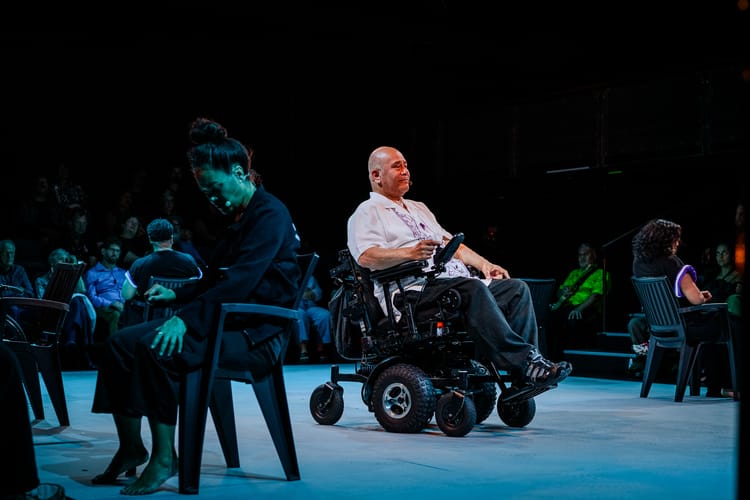
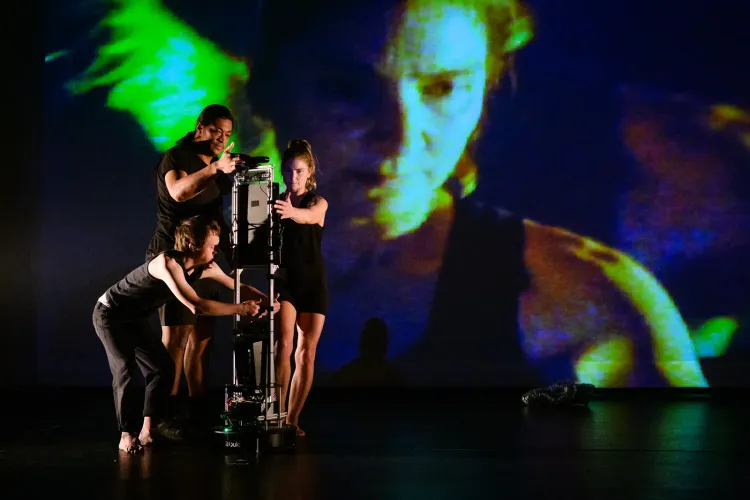
There are other directorial choices that mess with the message of Genuine and Stable. Occasionally, the cast move the set. Then sometimes, all the cast plus another person (a stage manager, or equivalent) move the set into the correct place. Sometimes, the cast onstage move it, a performance language introduced in the second half, never an idea time to introduce a new concept. These choices seem to be through neither rhyme nor reason but through necessity – and it’s hard to see how this pathway through necessity marries with what the script is, especially when the ensemble is moving the set into place. In these moments, the production homogenises the bodies of people of colour and people well, who lack it, in a way that is so fundamentally opposed to the play’s expression. It ends up as a bleak reminder that we (and I say this as a person of colour) can say these things and represent these symbols, but at the end of the day, if we have to move a desk, what we’re saying doesn’t really mean much because we have to move that desk to say it.
The design, warmly ostentatious as it is, gives and takes. Chye-Ling Huang’s set is gorgeously modular and unobtrusive, reminding us that, yeah, this is all a process and an office, good luck. Rhiannon Prime’s costume design feels like an assumption; as in here is how these women look like they dress as opposed to how they do dress (an assumption matched with action, why have blank paper and a fake mouse to refer to and a real keyboard?). Rae Longshaw-Park’s lighting design is often a dull chill, when it’s not completely missing lighting performers entirely, draining scenes of life and warmth.
But, man. That scene. It’s one of the best I’ve seen this year. It’s proof that when you write from knowledge, from understanding, from empathy, that you can set a stage on fire. I can’t recommend the full eighty minutes of Genuine and Stable but I can recommend the show for that scene. I sat back, I learned, I listened. I want something more from theatre, but I also want that.



Member discussion