Ghostfield: A Response
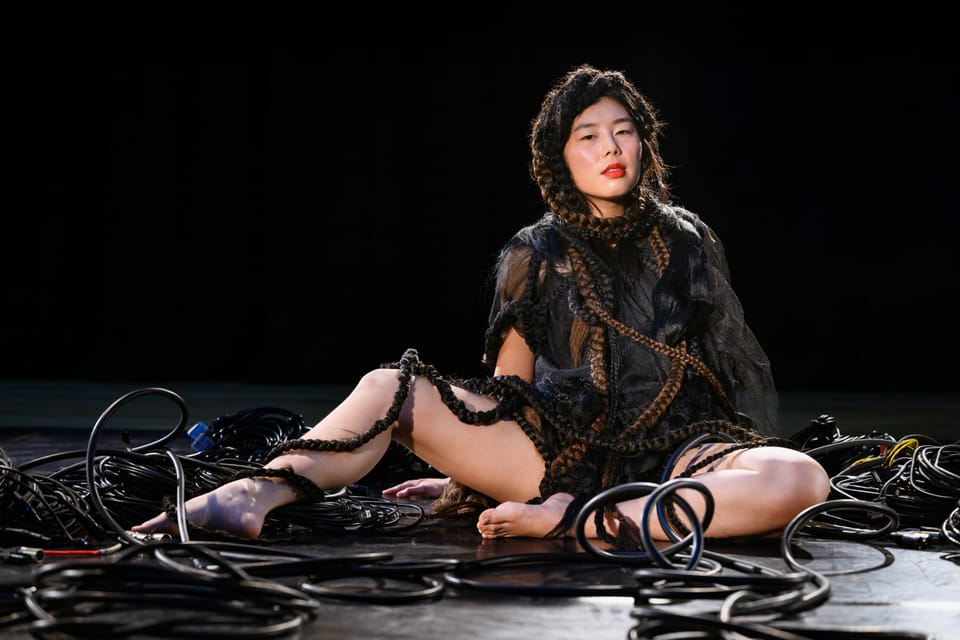
A response to Foster Group’s new work Ghostfield, a dance piece that blends the physical and projected.
How do humans create meaning? How do we define what is authentic? How do we express it? How do we perceive it? How do we process it? These are the questions I was left with after last night’s performance of Ghostfield, the new work by Foster Group, directed and choreographed by Sarah Foster-Sproull.
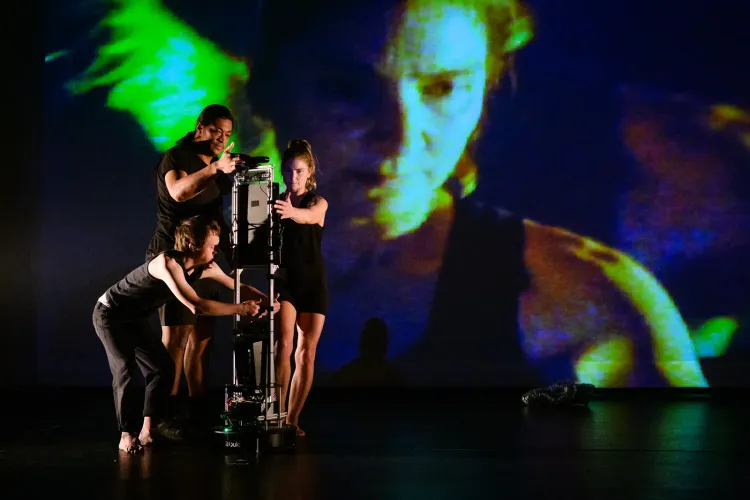
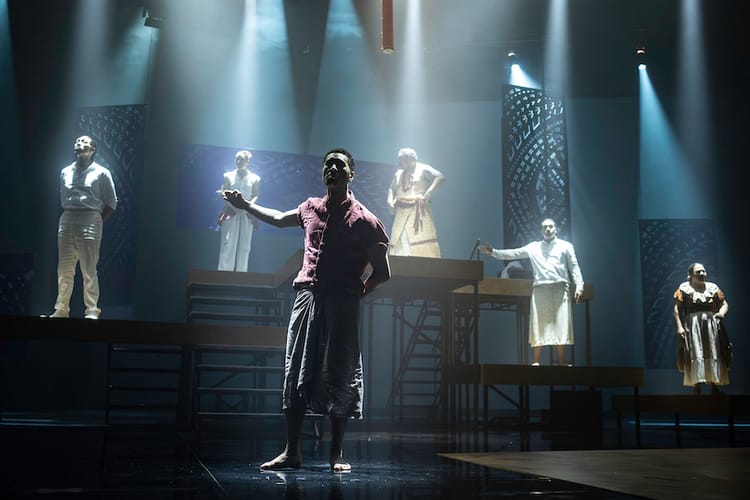
The show is a blend of both physical movement and 3D projected imagery, the latter in collaboration with arc/sec (Lab for Cyber-Physical Design). The show opens with three performers – Rosamund Philpott, Lulu Qiu, Aloali’i Tapu – lifting, spinning, and throwing themselves across the space. White spheres fall from the sky. The child in me wants to reach out and touch them, tactile as they are. The adult knows they aren’t really there, and that I’m surrounded by a soldout crowd. Still, the temptation is there.
After this initial movement – as much tech demo as it is setting the contract for what the audience is to experience – Ghostfield frames itself as a threeway conversation. Between the performers and the projection, between the performers and the audience, and the projection and the audience. A show about meaning that is interrogating the way that meaning is created, delivered, experienced and interpreted could be heady, even (and apologies for the scare-quotes) “academic”. But that material is delivered here remarkably viscerally and accessibly.
As the show develops, so does a language. The show comments on itself. Early on, the performers slapping their body emerges as a vocabulary. I hesitate to call it body percussion, given the gimmicky, even gaggy, implications that label applies, but it seems an appropriate label for performers making noises by hitting their own bodies. The word “slap” then recurs in later moments, Foster-Sproull potentially critiquing herself. What does it mean for a performer to hit herself onstage? What does an audience get from it? What does that do to a performer’s sense of self? She draws our attention to it, and moves on. An audience, especially when dealing with a non-narrative artform, creates their own meaning, whether you tell them it or not.
The 3D is the co-headliner here, and the big break with traditional form. It can be so easy to view the progression of tech and art with skepticism. I often think about 3D in performance or recording the same way that I think of VR in gaming. Is it integral to the experience or just a gimmick? Does the audience’s physical ‘sacrifice’, such as it is, warrant the tech’s inclusion in the art or does it become a distraction? However many years we’re into VR as an artistic experiment, the tech has yet to overcome the need for physical accoutrement to make it successful, and that accoutrement doesn’t come without some level of discomfort. I imagine at some point, audiences will get used to it, as we got used to tapping on a phone screen and got re-used to leaving the house to go engage with performance, but for now, it’s a barrier.
All of which is pre-amble to say that 3D is integral to the experience of Ghostfield, and even the accoutrement provided (classic red-and-blue 3D glasses) neither distract nor detract from the experience. There is something visceral about 3D projection, something enveloping about it, that reaches out even further than the obviously three dimensional space of live performance. Hands are a constant recurring motif; hands looping and entwining with each other in repeated movements. It’s an effective metaphor. Hands are such a common tool of expression – literally so for those who sign – and can be contorted so many ways. Towards the end of the show, when Ghostfield is at its most meditative, on the verge of folding in on itself, the hands repeat movements in ways that risk coming close to screensavers, but stay on the right side of that particular divide.
Thankfully, the rest of the design supports this tech. Eden Mulholland’s score, in particular, is as classically lush and stirring as always, but it leans into aspects of video game music; where movements loop and loop again, giving the impression you might be playing through a 20 minute suite rather than an extremely intricately designed two minute piece that is designed to play for eternity. The piece for Ghostfield’s final movement is particular impressive, as immersive aurally as the 3D is visually.
There is also an obvious virtuosity to the performance. In the moment, the three dancers are impressive; matching the choreography to the projection. In the aftermath and on reflection, it’s downright unbelievable. To perform in-sync with music and each other is one of the basics of dance (says the non-dancer). To perform in sync with imagery you can’t see, and will lack meaning without being in sync, successfully, in a way that creates that meaning, is something special. It speaks to Foster-Sproull’s choreographic mind that these performers being successful at what they do, at marrying their movement to the imagery, is as much a comment on the themes in the show as it an execution of those themes. What happens when a performer is “successful”? What happens if they aren’t? How does that impact an audience?
I’m left with more questions than answers after Ghostfield, which is frankly what I prefer from a show that is playing with form and content. There’s something cheeky about making a work about meaning and perception, using projection – and whomst amongst us hasn’t projected our own meaning – that is commenting on itself, and even the artform in which it belongs. I can imagine there are many dancers, choreographics, and other artists who work with the physical who will come away with different, deeper, thoughts than mine.
As someone who works with language, however, the questions I’m left with are more around the privilege of certain modes of expression, certain kinds of meaning. Why should definitiveness be viewed as authenticity? Ambiguity as lack of definition? Why does the written word, which can be twisted, softened, contorted, often take such precedence over the physical, which can do all of the same?
I’ll always take work that provokes questions with its material over work that gives me answers, happily so. When that show provokes questions about form at the same time, while also being such a virtuosic, high-level, expression of that form? I’m delighted.
Ghostfield runs at the Kenneth Myers Centre until December 17.
This response was commissioned by the producer, and as such is not labelled as a review. The producer has not dictated any of the material in this review, or requested any specific response. The views above are genuinely held by me (hello).
Member discussion