Some scattered thoughts on & Juliet

The hit Max Martin jukebox musical is playing across New Zealand this year. Here are a few scattered thoughts.
Jukebox musicals are, frankly, nobody’s idea of high art. They come about when a producer has an idea, then an acclaimed playwright is given the unenviable job of frankensteining songs that were never meant to exist alongside each other into a narrative structure. Sometimes those songs even have to fit the exact life story of the artist who sang them, which makes a lot of sense for artist and absolutely zero sense for others. While performers often thrive in them (unsurprisingly, good singers matched with good songs are a crowdpleaser), the actual final product is more tribute act than anything else. See: Jersey Boys, Jagged Little Pill, Tina: The Tina Turner Musical, MJ, Ain’t Too Proud, Beautiful, American Idiot, We Will Rock You, Mamma Mia, and countless other options. In short: It’s folly at this point to go into expecting Sondheim, hell, even expecting Lloyd-Webber.
In saying that, the idea of a Max Martin jukebox musical is kind of a genius one. Martin has written hundreds of songs for scores of singers, and what that catalogue lacks in cohesion, it makes up for in sheer numbers. There is also a musical consistency to all of his work that allows it to hang together with more ease than songs sung by the same person (who might have different songwriters and producers behind them). Additionally, Max Martin songs tend to, uh, be pretty great! You could make a five hour playlist from his songs and not have a single skip amongst them.
Additionally, if there’s someone to compare Max Martin to, William Shakespeare isn’t the worst one. Martin is probably the closest thing modern pop has to a Shakespeare [citation needed, probably, but go with me here]. In terms of breadth, reach, and longevity, if you were aiming to compare two artists from disparate artforms, you could do worse.
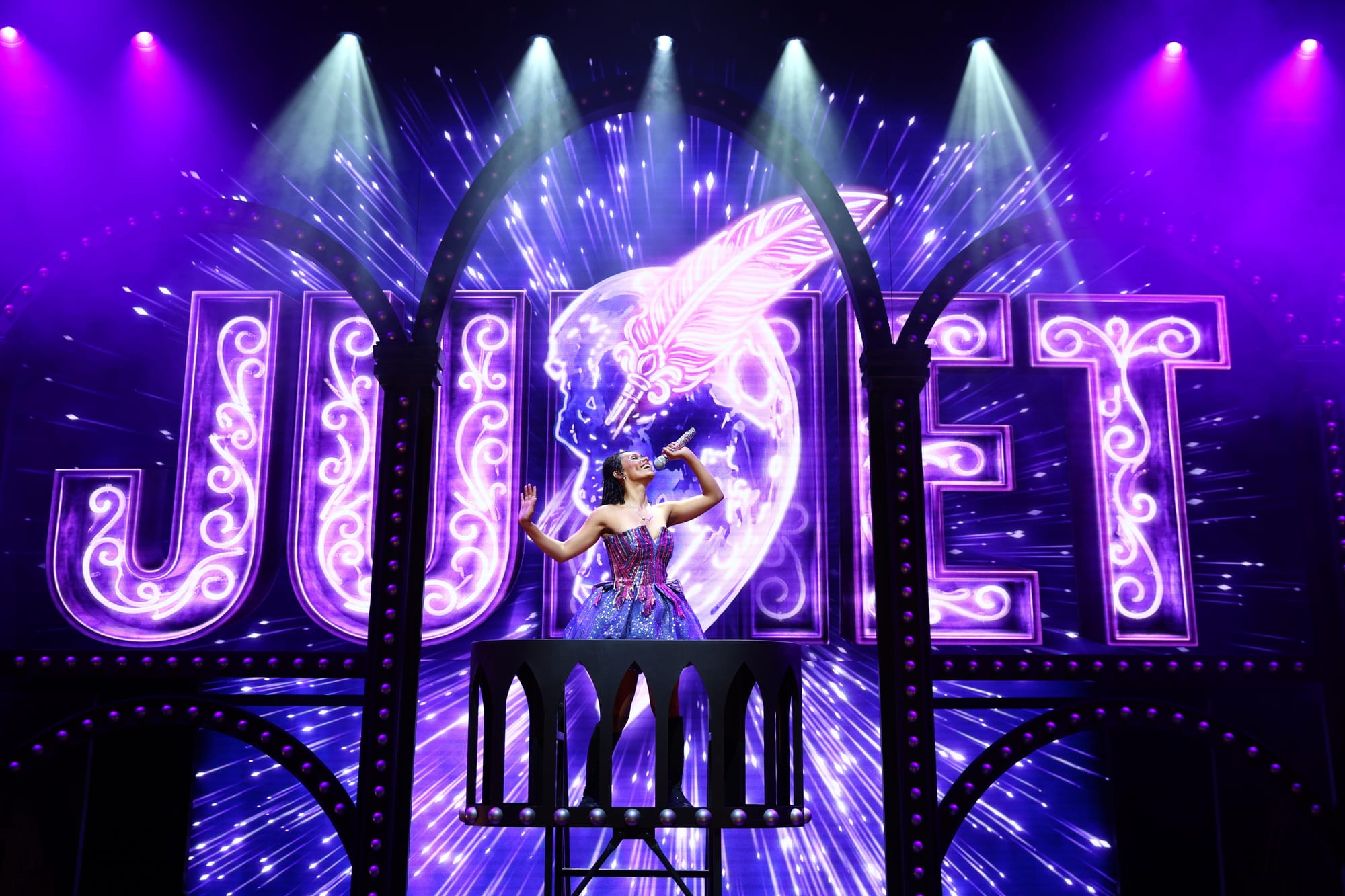
However, the plot that & Juliet pairs up with both of these artists is, to be frank, nonsense. The framework ends up being Anne Hathaway (Awhimai Fraser) taking issue with the ending of Romeo and Juliet, and deciding to write a third act where Juliet (Kristin Paulse) gets to live beyond the ending of that play. William Shakespeare (Matu Ngaropo) throws a few cogs in the machine. What follows is a “romp” (to be kind) featuring characters, some invented, some Shakespearean, following Juliet’s attempts at self-determination.
Almost immediately, the gap in quality between the songs and the speaking (to simplify it) is a gaping, Thelma-and-Louise-sized chasm. Max Martin wrote some of the most effortlessly lyrical, earwormy, songs of the past forty years. The jokes and characterisations in & Juliet are purely functional at best, microwaved at worst. There’s not a single ounce of musicality and rhythm to it, and while the cast are trying their best to bridge the gap, there’s absolutely no way to cover up that the songs are so, so, much better than anything else in the show. (To be slightly fair to the book, not all Max Martin songs were born equal, and some of the songs chosen in this are as close to clunkers as they can be. Is “Blow” anybody’s favourite song?)
& Juliet is also stuck in the same dissonant space between earnestness and archness that nothing ever really lands. It aims so hard for fresh, fun and funky, but ends up closer to tipsy aunty at the wedding requesting songs from the DJ. It asks an audience to completely buy into the arcs of these characters, but also buy into them making fun of the show they’re in, with countless winks to famous Shakespeare lines. (As a rule, it’s best not to draw attention to better artists than yourself within your own art. Probably unavoidable with this show and the referenced artists involved but still distracting.)

That’s unavoidable, though. It’s hard to blame this production for the flaws of the concept and the book. And what is unique to this production – the cast – is absolutely excellent. Awhimai Fraser and Lavinia Williams are particular standouts; Fraser essentially as the co-protagonist is exceptionally winning, her rendition of Celine Dion’s “That’s The Way It Is” is a landmark one, while Williams’ turn as the maid nails every punchline harder than it deserves, and her killer rendition of “Perfect” is a breath of fresh air. In this show, this work is less heavy-lifting and more Sisyphean pushing a rock up a hill. They can’t save the show, but every time they step onstage, they defibrillate it into life.
The ensemble is also giving their absolute all to this show. The choreography is high energy, asking them to be as much back-up dancers as characters in their own right. To see this many people work, to the height of their abilities, is an absolute joy. The closest this show gets to a pop concert, which is so obviously what & Juliet wants to be, and to evoke, is when the ensemble is onstage.
Which makes it sad to see that the actual production… looks really cheap. Which is distinct from being cheap, just as being cheap is distinct from looking cheap. Other than the cast, the stage feels bizarrely empty, consisting of mostly a revolve and other set pieces which are inelegantly rolled on and off (including a West Side Story-esque fire escape that unfortunately harkens back to an identical use in Hamilton). Rather than set, & Juliet relies on lighting (which is mostly flat washes and ostentatious movers) and AV projection to give a sense of both place and scale. It fails at achieving both. A backdrop that is meant to place us in a Parisian villa, for example, looks more like Luigi’s Mansion, with CGI from that exact same era of gaming. Later on, visuals that are meant to be evocative rather than literal look closer to what you'd see at a megachurch, not a pop concert, although the gap between those two gets smaller and smaller as time goes on.

Even more galling is the projection of LED lights. The intended effect, which is to mirror a pop concert, falls completely flat. Mostly because it’s obvious that we’re looking at a flat projection of lights (which does not give off much light at all) rather than actual lights (which, as the name suggests, does give off light). The goal, clearly, is to masquerade as spectacle, but it’s so obviously not the thing it’s trying to be that it looks worse than if it wasn’t attempted at all.
This lack of spectacle means that the cast is too often left providing the special effects, which, in this case, are the singing and the choreography. If there’s anything to recommend about this production at all, it’s that the audience gets to spend a couple of hours with fantastic singers and dancers doing their best to bring all-time bangers to life. A bare bones production and lacklustre writing might detract from the experience, but it can’t take it away entirely.
& Juliet plays in Auckland until May 3, then tours to Wellington and Christchurch across May and June.
Member discussion