Waiora: A Response
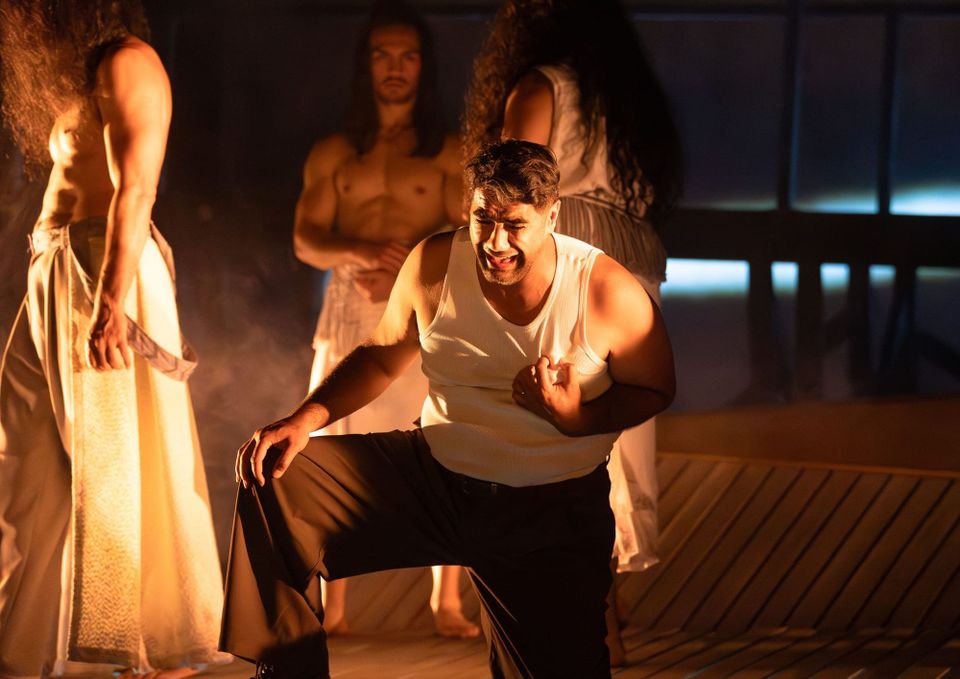
A response to Waiora’s 30th anniversary production, a huge undertaking of a legendary play.
There’s the obvious thing: Hone Kouka’s Waiora (Te Ukaipo – The Homeland in full) is one of Aotearoa’s best plays. A family drama about dislocation, colonisation, and intergenerational trauma; it reads as though it could be written yesterday, when in actual fact it is as long from the play’s debut in 1995 as it is from when the play is set in the 1960s. There’s a reason why it is studied, and a reason why a production is a big deal. Kouka directs this production, which is a massive collaboration between four pou of Aotearoa’s performing arts scene: The Aotearoa Festival of the Arts, Auckland Arts Festival, Auckland Theatre Company, and Tawata Productions (referred to alphabetically, not in order of importance). It is an event by any measure of the word, and thankfully, the production meets the expectations.
After an extended opening – a section of movement that sets up a certain language but also, unfortunately, prevents the play from actually starting – Waoira launches into itself at a clip. It feels like damning the play with faint praise to to say that the characters, relationships and viewpoints are all so clear, but it’s also a reminder that establishing all these things so quickly is really hard to do. When Erina Daniels’ matriarch Sue defers to Mycah Keall’s schoolteacher Louise, it’s so clear that she is deferring to her only as a guest, and how fluent she is in doing this, while remaining steadfast in her own house. It is uplifting the show with real praise to say that Kouka’s dialogue hits with as much a punch as I can imagine it did on its premiere. It hasn’t dated one bit, he knows when to lean into the poetry of a monologue, and when one word can slice like a knife across someone’s soul.
Dialogue aside, Waiora finds beauty within a simple structure: Hone (referred to as John by the Pākehā, and played by Regan Taylor) is the star worker at a timber mill in Southland, where he has relocated his family from their homeland to work. He has invited his manager Steve (Ben Ashby), with the expectation that he might be receiving a promotion.
None of Hone’s children are perfect hosts. Rongo (Tioreore Ngatai-Melbourne) is not just physically displaced, but emotionally and spiritually displaced. Her quiet watching of events unfold could not be any less content. Amiria (Rongopai Tickell) is rebellious, longing not for homeland but for the noise of the city. Boyboy (Te Mihi Potae) only wants to please and meet Hone’s expectations, and consistently falls short of them. Meanwhile, the family’s tipuna (Anatonio Te Maioha, Awerangi Thompson, Mathieu Boynton-Rata and Huia Rawiri) watch over the action, reacting in some instances and falling silent in others. In other words: The stage is pretty damn full.
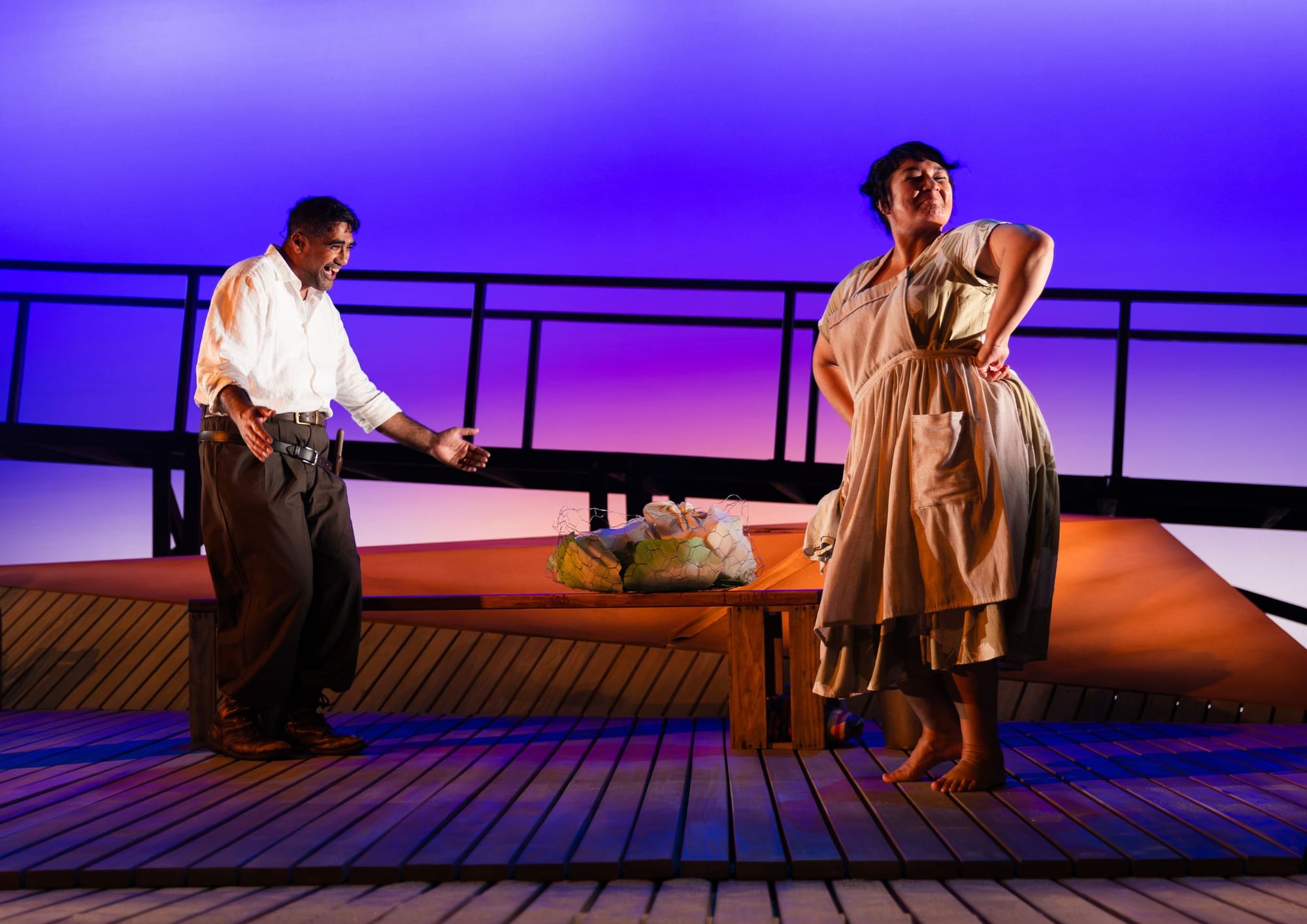
Like the best family dramas, Waiora is a train heading slowly, but surely, off the tracks. After the opening, Kouka keeps the show moving along at a clip. It’s here that the modern audience contributes a bit; the behaviour of Louise and Steve as the resident – or interfering – Pākehā is received with recognition that they’re being subtly, and not so subtly, racist. The laughter of recognition is cold, intentionally so, and the show does well to keep the audience laughing in the right way; always with, never at.
This production centres the parents, Hone and Sue, in a fascinating way. It could be a function of time – we’re looking back at all these characters, regardless – and it could be a function of where Waiora sits now. We’re so familiar with the plights of the children, Rongo in particular, that we want to hear from the parents. We want to see Hone break, we want to see him admit fault. Likewise, we want to see Sue call out her husband. These are massive gestures as written, but as performed in this show, they feel even more momentous. Daniels, especially, pulls moments for Sue towards the end that stab right under the ribs. As written, I’ve always seen Waiora as a play of meaningful silences; of words and conversations deferred, not addressed. This production shifts the focus to what’s said, to what’s seen (the tipuna’s reactions to events occasionally included). It’s a big shift, and one that I imagine will resonate differently for different generations.
The design is also front and centre in this production. Mark McEntyre’s set and Natasha James’ lighting are in pure concert with each other. The set feels at a crossroads; the halfway point between an suburban house and a rural bach. It also feels slightly otherworldly, slightly alien. James’ lighting leans into the otherworldly nature; beautiful oranges offset with pinks and purples. Sunsets that could be beautiful feel instead horrible and icky. It all contributes to the feeling that this isn’t right. This isn’t home.
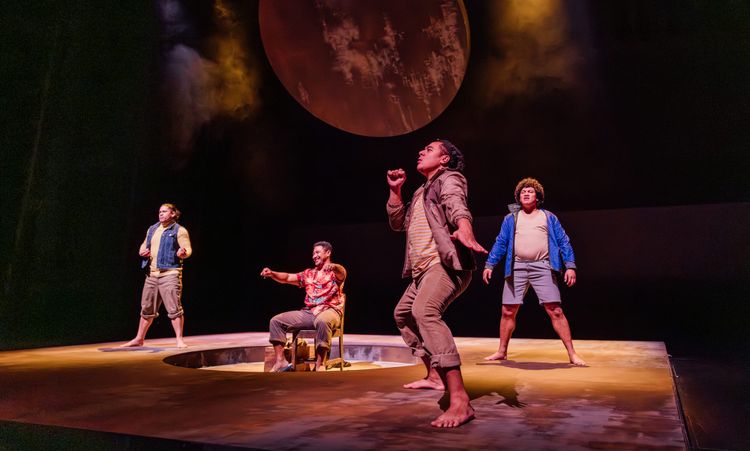
It also, crucially, gives the production a sense of scale. Waiora is a big play, as written, the kind that rarely gets written in New Zealand, let alone performed. I can see an intimate version of this show, but the ASB Waterfront Theatre doesn’t lend itself to intimacy (it shouldn’t, really). Kouka’s direction aims to meet this scale, but occasionally the production doesn’t quite get there. The cast are directed into the kind of declamatory performance that is often required at this scale, less often required in this day and age.
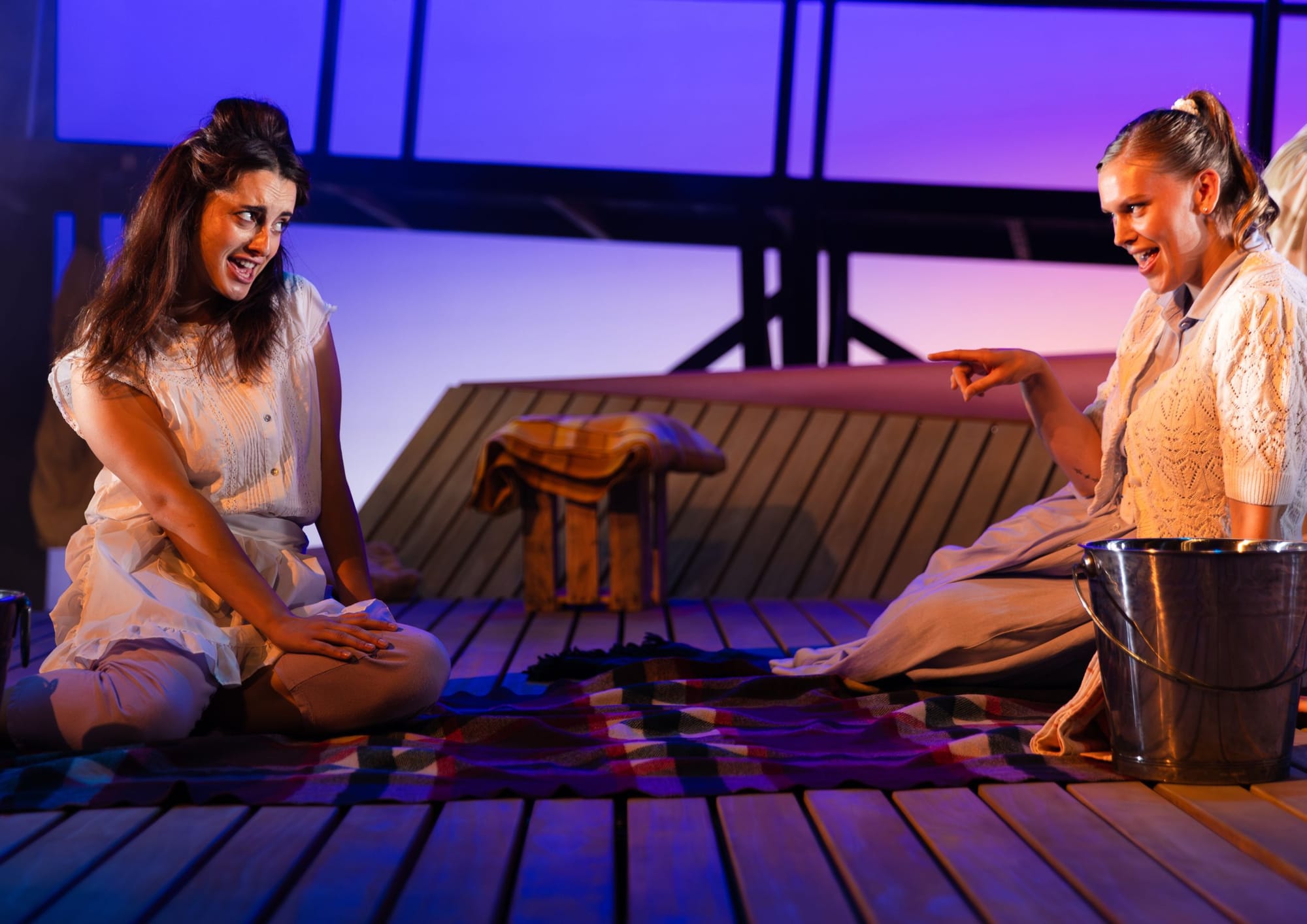
There’s nothing inherently wrong with declamatory acting, I’m a big fan of going Big to reveal Big Truths, but there is a disconnect between some of the more experienced cast, almost certainly more used to this kind of performance, and the younger cast, who tend more towards low-key, naturalistic, performances. Those low-key moments lead to moments of quiet beauty if you’re looking for them; Tickell’s Amiria playing solitaire, Ngatai-Melbourne’s Rongo peeling what must be her thousandth potato, looking all the world like she might turn the knife anywhere else. As written, Waiora sits somewhere between the two registers, but it can occasionally lead to separate worlds existing onstage in relief to each other, rather than conversation. (Which, honestly? Is probably fitting, given the subject matter.)
Any quibbles with the production are just that, quibbles. Waiora is more resilient than most. The last half hour is as strong as anything put on stage in this country. Kouka’s words sit alongside the waiata and haka, and in turn those waiata and haka elevate Kouka’s words. The cast does justice to the words. The design does justice to the words. And ultimately, the production does justice to the legacy of the work. There was every risk of this show simply being a continuation of the conversation that Kouka started in 1995, people still speak about that production to this day, instead it sticks its own stake in the ground. Waiora has been relevant for 30 years, no doubt it will be relevant for 30 more.
Waiora Te Ūkaipō – The Homeland plays at the ASB Waterfront Theatre until March 22 as part of Auckland Arts Festival. It was presented in collaboration with The Aotearoa Festival of the Arts, Auckland Arts Festival, Auckland Theatre Company and Tawata Productions.
This review was commissioned by Auckland Theatre Company. You can find more information about this commissioning structure here.



Member discussion