Critical Corner: Auckland Arts Festival Week Three Round-Up
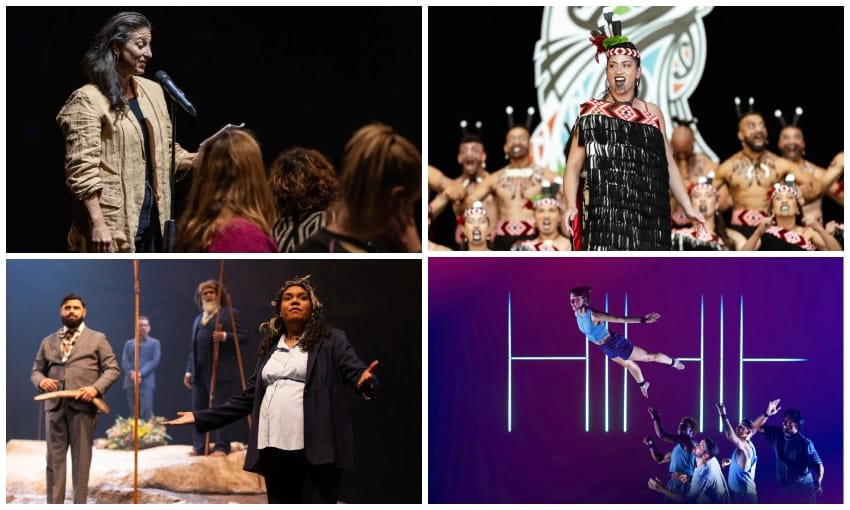
In this edition of Critical Corner, reviews of Sincere Apologies, Ten Thousand Hours, Ihi. Wehi. Mana and The Visitors.
Sometimes you see a show that leaves you thinking for days afterwards. Oftentimes, that’s a good thing! If you see enough bad shows, or shows that aren’t to your taste, it’s easy to put it aside. Thinking about a show tends to be an appreciation of its worth, of what it is trying to say. Sincere Apologies sits somewhere in the mire of this – I’ve been thinking about it a lot, but I’m not necessarily sure I liked what it was getting at.
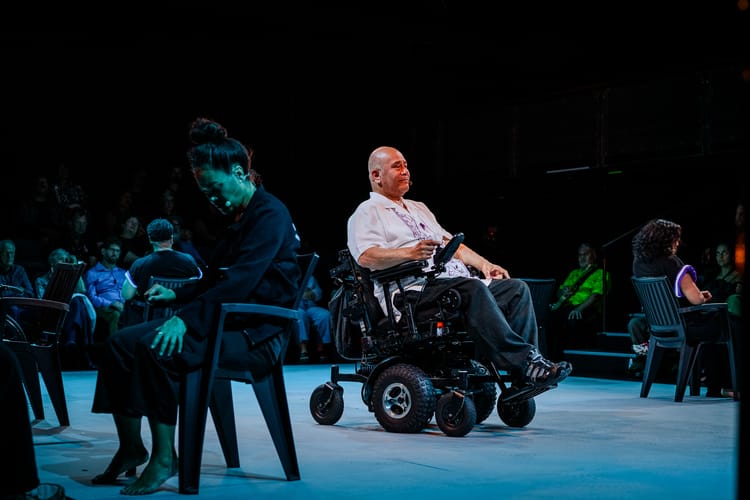
The show, billed as “one part theatrical ritual” and “one part social experiment”, is an interrogation into the nature of apologies. After a simple setting up of premise, the audience is informed that everyone will be reading apologies – some famous, some imagined, some personal, some private, some public – until they get through the 51 apologies that the team have assembled for us. Presumably, these change depending on where the show is performed, with some notable New Zealand apologies being included, such as Paul Henry’s apology to Anand Satyanand, and Jacinda Ardern’s apology to the Pasifika community for the Dawn Raids.
As a social experiment, it works. It’s fascinating how quickly the audience complies to reading these apologies, and there is a calming beauty in the communal nature of it. All of the apologies, however, feel somewhat facile, being read neither by the apologee or the apologised to. No amount of performance or community participation can really change the fact that an apology is an interpersonal interaction that is the result of some action by one person against another. To remove both sides of the apology robs it of weight, and of meaning. (This is even more true of the fictional apologies, with winks to potential future Prime Ministers; these mean even less because they’re speculative, and archly speculative at that.)
This is also where I think the show falters as a theatrical ritual. The show, written by Dan Koop, James Lewis, and David Williams (based on a concept by Williams and Robyn Oakes) doesn’t have a strong enough framework to deal with the heavier apologies in the show. An apology from the Crown to the survivors of abuse in state care is a massive, frankly unresolved, trauma, and given that the makers of the work aren’t present in the space to hold the weight of that, but instead rely on the audience to do that work, feels like an abdication of responsibility. Something that might call for an apology to someone, somewhere, perhaps.

Sometimes you love a show uncomplicatedly. I loved Gravity and Other Myths’ Ten Thousand Hours when I saw it in Edinburgh back in 2024, and I loved it just as much when I saw it at The Civic last week. As I’ve mentioned before, circus is one of those forms that can have unfairly diminishing returns for an audience; there’s only so many times you can see human beings perform death and physic defying feats before you start to get inoculated to being impressed by them.
Ten Thousand Hours is one of those shows that remind you that circus is ridiculous, actually, and part of what makes it so is that there is always the sense that what the cast – who number just under ten – is doing is actually really difficult. It’s the result of years of training, countless hours of practice, and making it look easy is part of the gig. I’m in the section of the audience for this kind of show that deeply values the art in athleticism, and Ten Thousand Hours delivered. It’s not just the build up to the big stunt at the end, which made me feel bad for my slightly dismissive comment about the ease of “standing on shoulders” in my piece last week, but the sense of play and joy from impressing an audience throughout.
That sense of joy carried in me through to Ihi. Wehi. Mana., a collaboration between kapa haka ropu Te Waka Huia and choirs lead by Dr. Karen Grylls. Another show of scale, perhaps the biggest “cast” of the festival, it took place at the Dame Kiri Te Kanawa Theatre, and was commissioned to celebrate the 30 year anniversary of these two groups performing at the Sydney Opera House.
While the two groups excelled in their own forms – the choirs performing first, Te Waka Huia performing second – the drawing card was seeing them perform together. The gorgeous, beautiful, high notes of the choirs blending with the lower notes of the kapa haka ropu was a sound I’ve never heard before. It’s a shame that these one-off events are just that, one-off, but if there’s a place for them, it’s the festival, and if there’s a venue for them, it’s the Dame Kiri Te Kanawa. A definite standout of the three weeks for me.
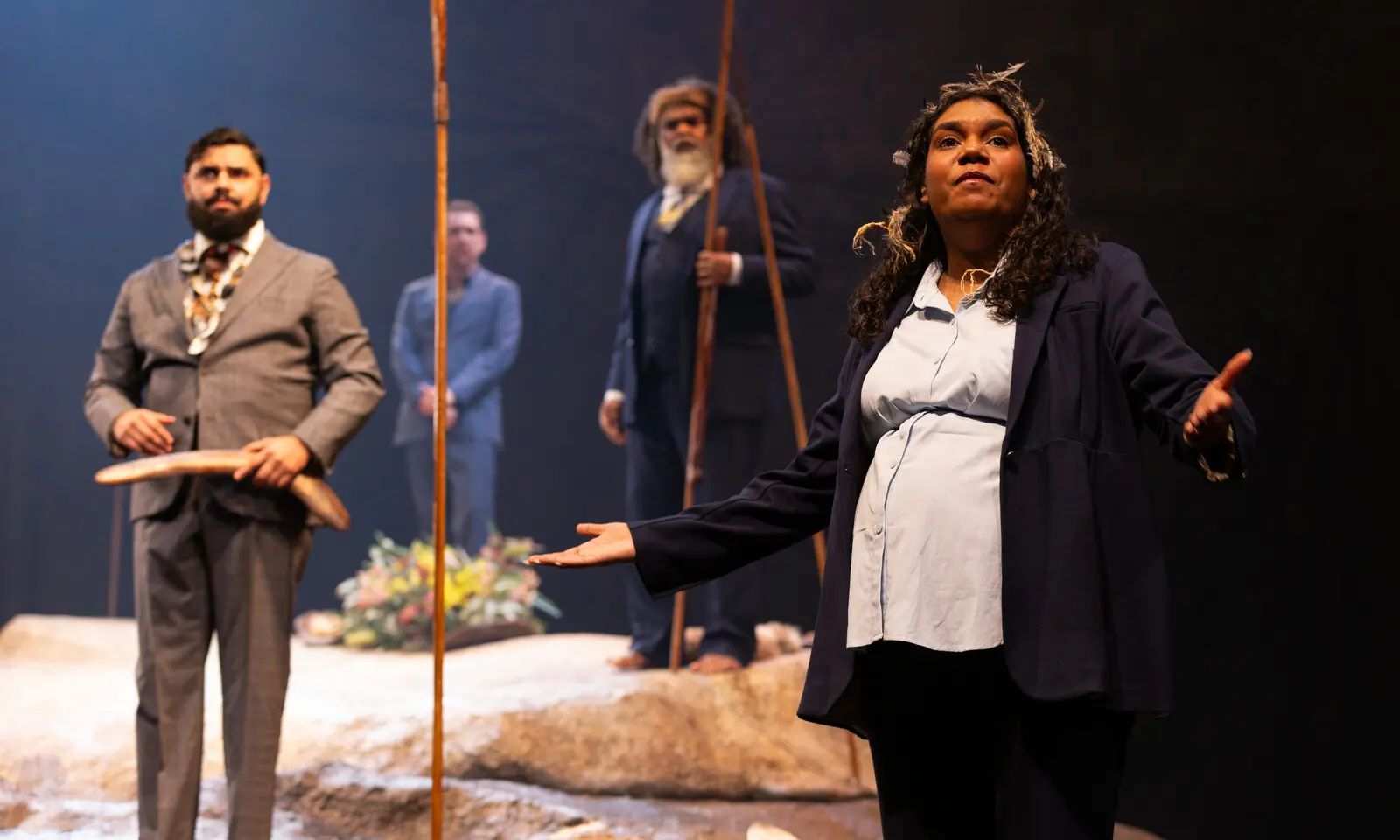
My last show of the festival was The Visitors, blessedly a show of scale. A pregnant woman sits on a rock, staring intently out at the audience, watching and waiting for something. All of a sudden, she is joined by six other clan leaders, dressed in modern professional garb but wielding swords and shields.
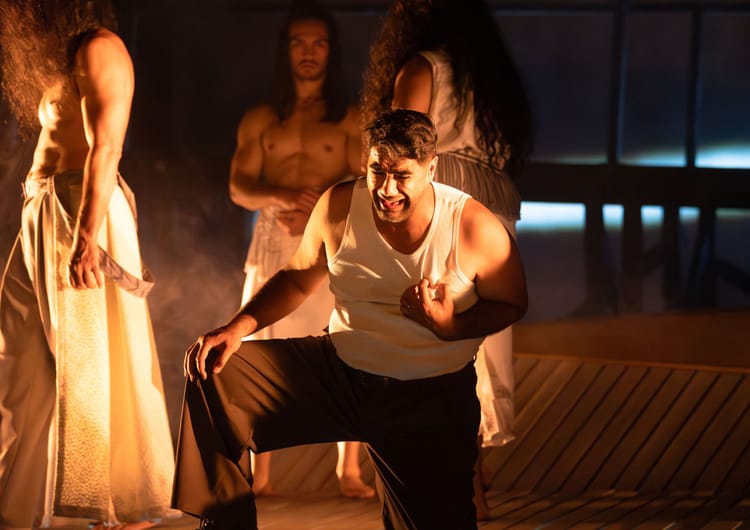
Watching The Visitors is a little bit like watching a train crash in slow motion, or to use a mode of transportation that is closer to the material of the show, like watching a sinking ship. The play, written by Jane Harrison and directed by Wesley Enoch, is brilliantly effective. The premise is relatively simple: One day in January 1788, seven clan leaders assemble on an outcropping overlooking Sydney harbour to decide on what to do regarding the nawi (giant boats) that are gathering below them. Do they let them land, or do they fight them off?
We, the audience, know what happens afterwards. Colonisation. The play unfolds slowly, with each of the clan leaders slowly being convinced, persuaded, or giving in to their own self-doubt, moving from “fighting them off” to “letting them land”. It’s a brilliant feint by Harrison, to have the “most reasonable” character argue for letting the nawi land, bringing up arguments about how it’s their tradition to welcome people to the country, how the people on the ships have always left when they’ve come before, and why they can’t resort to violence. In the audience, we’re begging this character, brilliantly played by Najwa Addams-Ebel, to fight them off.
As the clan leaders argue in circles, telling stories of “judder bars” (muskets) and the bizarre behaviours of the would-be landers, The Visitors ends up being a rejection of the entire idea of colonisation. What makes these people leave their country? What makes them want to stay? Why do they act first with violence rather than with warm open arms? There are no real answers to these questions, which is where the true horror, and true absurdity, of the show lies. Harrison presents colonisation as something unjustifiable and unthinkable, which hits harder watching the show on colonised land. The show isn’t just a critique of a couple hundred people landing in Australia in the 18th century, it’s a “what the fuck” about the entire reason that so many of the audience are in the audience in the first place.
Again, there’s no answers there, but I’m happy – in a way – to sit with the questions.
(If you want to read more of my Auckland Arts Festival coverage, you can check out my wrap-up of the festival over at The Spinoff.)
All four shows played as part of Auckland Arts Festival.
Writing and reporting takes time, and if you want to support the amount of time it takes (and ensure that the scant amount of meaningful coverage of local art can continue), please considering supporting Dramatic Pause with a paid subscription ($8 p/m, $60 p/a) and if you can't afford a paid subscription, please share the work with your networks!
Member discussion