Critical Corner: Music Portrait of a Humbled Disabled Samoan; E Ipo, My Love
In this edition of Critical Corner, reviews of touring arts festival show Music Portrait of a Humble Disabled Samoan and E Ipo My Love.
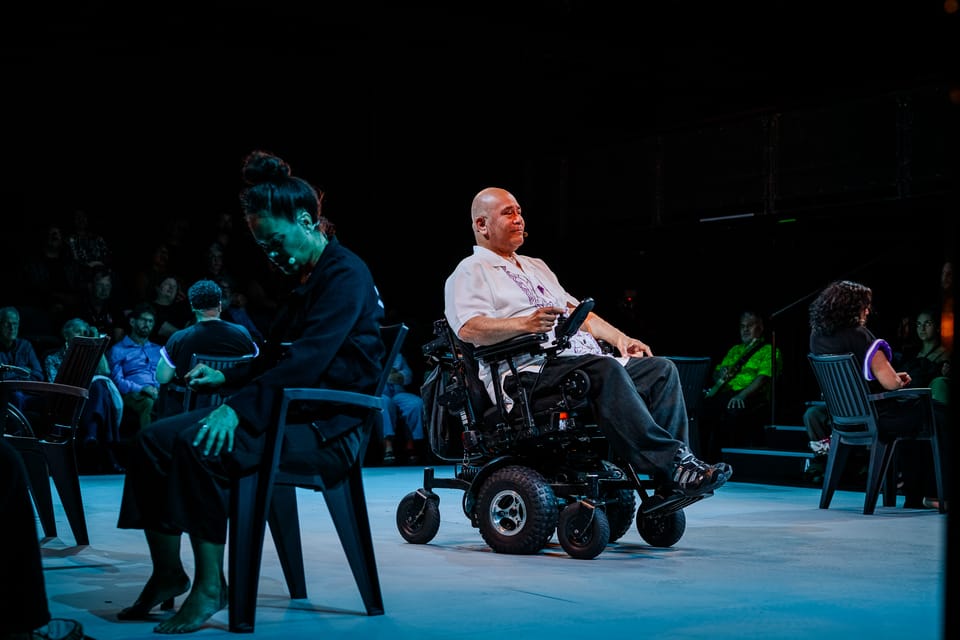
Music Portrait of a Humble Disabled Samoan (Portrait hereafter, for brevity’s sake) is the story of Pati Umaga – Fonoti Pati Peni Umaga QSM – a pioneer and musician who became tetraplegic after an accident in 2005. Since then, he’s become an activist and advocate for the Pacific and disability community. This show, directed by Nathaniel Lees, tells his story from birth to the present day.
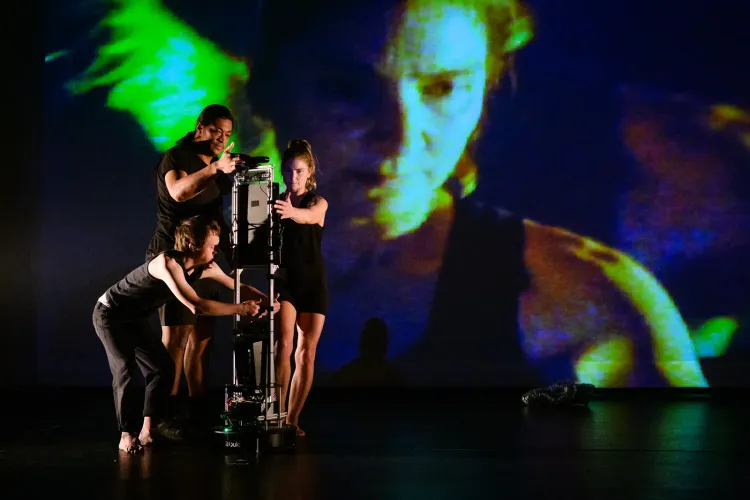
Although Umaga is the centrepiece of the show – often performing from the centre of the stage – he is supported by several other musicians and performers onstage. It’s a clever conceit, one that supports the idea that there are many ways to tell one story, and perhaps the best way to tell it isn’t with one uniform performer. Above all the performers sits an AV screen (projecting footage 360, so not sure if “screen” is the right label, but imagine a chandelier and that’ll get you closer to it) which shows stories that illustrate Umaga’s youth, from being born in Wellington, to growing up in Wainuiomata, and rejecting the prescribed pathways of priesthood and lawyer to instead make his way in music.
Occasionally the form of the show can feel a little remote; the script settles into a register of storytelling that feels more committed to making sure every detail gets told, rather than attending to the poetry of Umaga’s story. It’s a tricky balance for any show – how to balance what the audience, regardless of background or access, needs to know to understand it, and when the rush of facts can be slowed down or observed from another angle for art’s sake. The performers, and the form, of Portrait seem attuned to the rhythms of Umaga’s life, and his art, but the script seems to lag behind.
Ultimately, it’s an absorbing experience – thanks hugely in part to Umaga’s massive charisma as performer and human. Even if he weren’t supported by multiple performers, the show would feel full just because of his presence. The performers help of course, and lend a playfulness that might be lost if it were simply Umaga onstage. Not for any lack in Umaga himself, but it feels right that an activist and advocate is surrounded by those he speaks for, and speaks to, the most.
The response of the crowd on Auckland’s opening night was moving, and if there’s ever a show that benefits extraordinarily from being in the round, allowing the audience to feed in energy as much as they feed in attention, it’s this one. I reject labels that come so easily as “inspiring” or “uplifting” to describe work by disabled artists, instead this show is an example of the kind of work that could – and should – be on our stages more often.
Biculturalism is, unsurprisingly, a frequent area of interrogation for artists in Aotearoa. It’s the fabric of the nation, and, to understate it, a complex fabric at that. Theatre is no exception to interrogating this, from much of Taki Rua’s work in the 90s, right through to the iconic Niu Sila, and more recently, works like Vanilla Miraka, Sing to Me, and The Aotearoans. E Ipo, My Love joins a storied legacy of exploring this, and proves itself both worthy and distinct of its place.
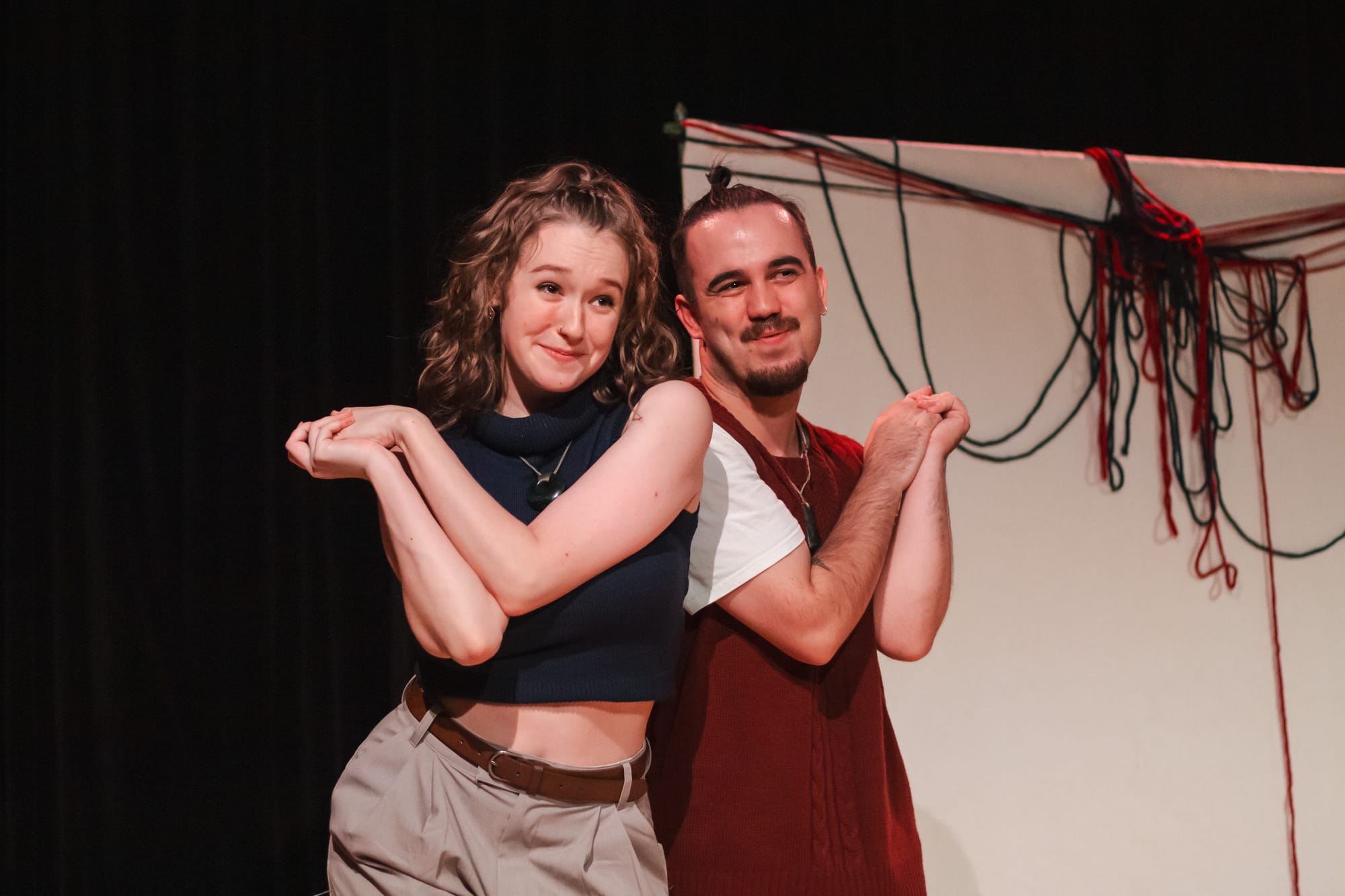
E Ipo, My Love is a blend of forms, weaving puppetry and mask amongst sketch and more naturalistic storytelling. We follow a couple from their first meeting through the years, and the troubles, travails and ludicrousities that it means to navigate a life together as a bicultural couple. While the show dips into thorny spaces, it never lingers there too long; this is a gentle, exploratory work, not an excoriating one.
Tane Te Pakeke-Patterson and Gisele Proud are the co-creators and performers of the work, and they have an immediate rapport and chemistry with the audience; charming without being ingratiating. It shouldn’t be surprising that the creators and performers of the work share sensibilities with that same work, but there’s a marriage between everything onstage that feels deeply, pleasantly, cohesive. This isn’t Who’s Afraid of Virginia Woolf? and it’s not Waiora; gentle truths and realities are just as valid as the violent, earth-shattering ones.
“Pleasant” is generally not a hugely profound area for art to rest in, but E Ipo My Love finds an elegance and even a depth in being deeply pleasant to watch. It’s a winning choice to pair the naturalism with lo-fi theatricality – a “swimmer”, so to speak, bantering with an egg is a special highlight. Warmth opens an audience up to an experience, and it allows the smaller moments to really thrive; Te Pakeke-Patterson’s character of Hemi feels like the charismatic-but-slightly-awkward uncle that shows up at family BBQs, not sure of where he belongs, while Proud’s character stepping onto a marae in the late stages of the stories will ring true to any Pākehā having that experience for the first time. It may seem to be damning the show with faint praise to call it “winning”, “pleasant” and “charming”, but those are tricky areas to do well, without feeling monotonous or even slight. E Ipo, My Love is never either; always bright, always entertaining, and so clearly full of thought and curiosity.
Artists in Aotearoa will keep making work about biculturalism as long as biculturalism exists in the country, so pretty much for the rest of time. As long we exist in cultures that co-exist with each other, we will need art that interrogates how we make sense of our differences, similarities, and collisions. To rip off one of Bic Runga’s album titles, E Ipo, My Love focuses on some of the more beautiful of those collisions, and it does so without sacrificing intelligence or incision. It might put too fine a point on it, but it’s proof that this biculturalism thing doesn’t need to be traumatising, and it can sometimes lead to things of grace, of beauty, of shared understanding.
Music Portrait of a Humble Disabled Samoan played at Auckland Arts Festival last week, and plays at the Aotearoa Festival of the Arts this week.
E Ipo, My Love plays at Basement Theatre through to the 14th.
Other Things I’ve Consumed
- I saw Waiora over the weekend, also playing as part of the Auckland Arts Festival. I recommend it!
- If you have a 30 Rock or The Unbreakable Kimmy Schmidt shaped hole in your lives, I highly recommend you get into The Fall of Rise of Reggie Dinkins, which shares writers from both series. It’s about disgraced sports star Reggie Dinkins (Tracey Morgan, riffing on Tracey Jordan without being too explicit about it) trying to make a documentary about his life, and the documentarian (Daniel Radcliffe, leaning into the weirdo comedy aspect that he has done so well at post-Harry Potter) trying to make it happy. It’s delightful, with a similar joke-per-minute (per second?) ratio to the aforementioned shows.
Other Things to Read
- I’m honestly not reading anything but the newsletter is gonna be a bit full in March due to Auckland Arts Festival!
Writing and reporting takes time, and if you want to support the amount of time it takes (and ensure that the scant amount of meaningful coverage of local art can continue), please considering supporting Dramatic Pause with a paid subscription ($8 p/m, $60 p/a) and if you can't afford a paid subscription, please share the work with your networks!

Member discussion