Sons of Vao: A Response
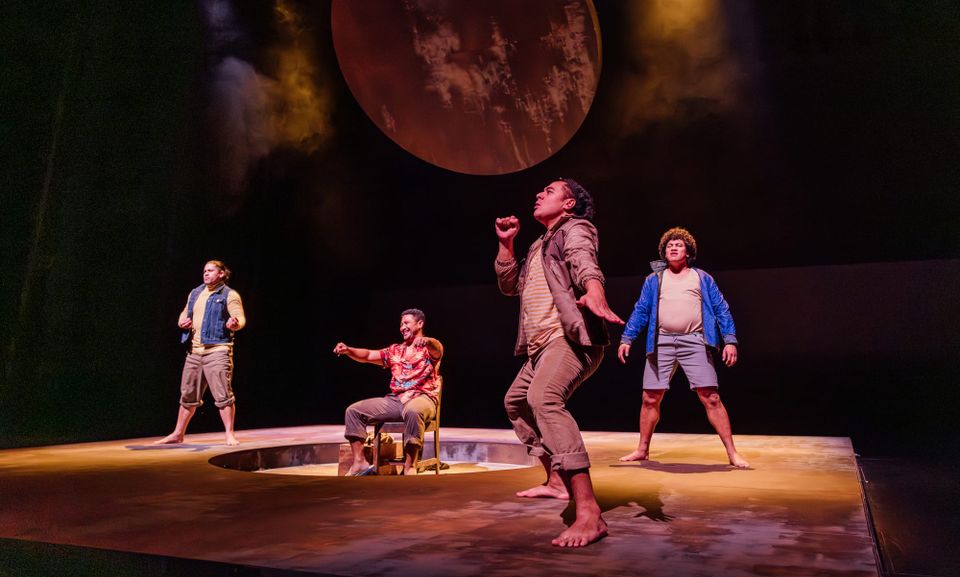
A response to Sons of Vao, presented by Auckland Theatre Company, a play written by Vela Manusaute spanning four decades, two countries, and one family.
Sons of Vao opens simply and elegantly. A sheet brushes back and forth on an empty stage, revealing with each brush a little bit more of what we’ll end up seeing. A single chair onstage. The titular Vao, played by Beulah Koale. The titular sons, played by Haans Fa’avae-Jackson, Epine Bob Savea and Brett Taefu. A few brushes later, we’re in Niue. The year is 1970. Through the next hour, and change, we’re presented the story of these men across the next four decades, as they grow up, moving to Niu Sila, and live in such close proximity to each other that they might as well be breathing into each other’s mouths constantly.
Auckland Theatre Company’s production, co-directed by Anapela Polata’ivao and the playwright Vela Manusaute, also marks the play’s world premiere. Fittingly for the show’s material, Sons of Vao sits across many worlds. It is the story of one family as much as it is the story of many families who emigrate to New Zealand, Niu Sila, in search of a better – or at least different – life. It is a family drama, a black comedy, a memory play. Despite the comparatively small cast and minimal design, Sons of Vao is aiming to encapsulate a lot of things, and it does so successfully.
Given the size of the production, it’s Manusaute’s writing that evokes the setting, and the time period, the most. This, then, puts the focus on the performers. Haanz Fa’avae-Jackson, as eldest son To, is flat-out brilliant. Vao might be the title character, but it’s To’s journey from childhood to adulthood that forms the backbone of the play. Fa’avae-Jackson doesn’t just track the emotional journey beautifully, he hits every age across the thirty years with great specificity. As Seki and Sou, Epine Bob Savea and Brett Taefu round out the cast with vivid, boldly-coloured, performances. These characters are more broadly drawn than To, but both actors are grounded and specific enough that they still read as palpably human.
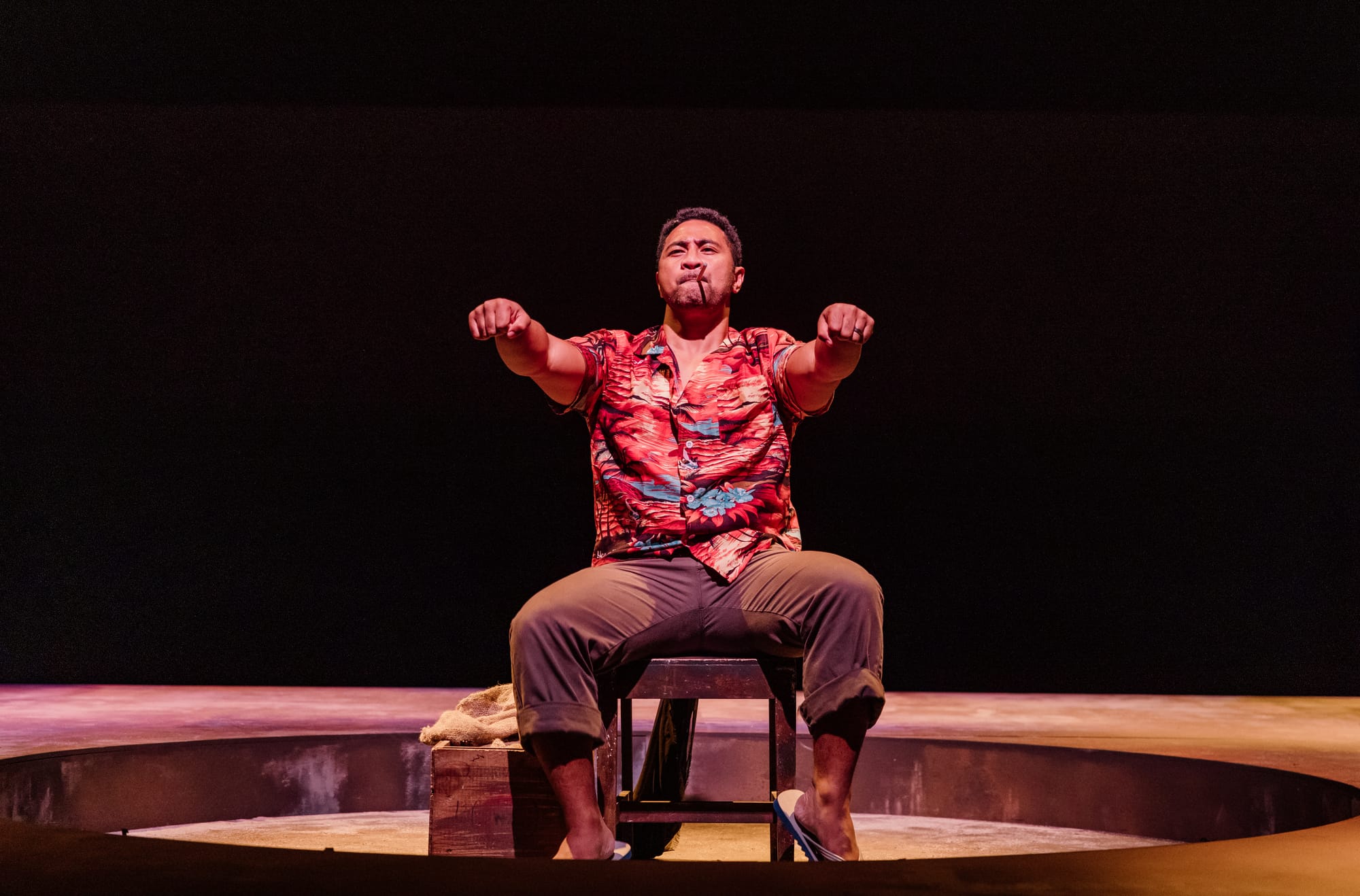
Koale has a difficult job as Vao; a character who has to hang over the entire play as a spectre but also be terrifyingly present. Vao also can’t be a caricature, he has to be as real and as human as everybody else in the play. Perhaps the biggest triumph of Manusaute’s play is how Vao is a tragic figure who also feels extremely relatable to anybody who has known a man of a certain age, from a certain background. He’s a man robbed of empathy, robbed of language, and bleakly, robbed of love, in ways that make him destroy all those things in other people. In short, Koale nails it. It’s a big performance, and one that makes Vao seem appropriately mythic, but he picks the right moments to shrink Vao down to his lowest, and his smallest. It’s also a performance that can’t help but recall the actor’s very recent work in A View from the Bridge, and it’s remarkable that he can deliver two starkly different performances within similar emotional spectrums.
Manusaute’s writing balances more low-key, realistic dialogue and poetry, but more importantly he has a very clear sense of tone. It could be easy for Sons of Vao to wallow in the darkness or revel in the shocking things that the family goes through, but the plays move along at a clip; no trauma is truly lingered on because, well, the characters have to keep on living life. While the play never feels rushed, it sometimes feels almost too elegant, which turns the dial down on some of the heaviness in the play, in particular the violence, both physical and emotional. It’s difficult, and perhaps properly impossible, to do a show in the round in the ASB Waterfront Theatre, but it made me wonder if this was a story that really wanted to be in the middle of the audience, rather than a stage in front of us.
The one tension that sticks from Sons of Vao is that it evokes more than it depicts. The audience is being asked to believe these actors are ageing from childhood, through their teens, into adulthood, which requires quite a bit of buy-in from a crowd, regardless of the quality of the performances. Projections of blue skies and starry nights stand in for locations that are described with such precision in the script. The bare stage, with Vao occupying the pit in the middle, is a blank canvas that we’re invited to imagine upon and around. This kind of imagination is what we’re used to in the theatre, especially in New Zealand where more often than not production design and audience imagination are key collaborators in getting a show across the line, when budget lines are unable to compensate. At times, the elegance of this production, the inventiveness of the direction, feels like it is not dulling the impact, but putting it at a remove from the crowd. The family becomes neighbours, rather than relatives.
While it might soften the blow, Sons of Vao is still something to be admired. There are so many grace notes, in the performances, in the direction, in the design, that make it a worthy night. It’s still a story that has been lived so many times on our shores, but so rarely explored on a stage of this size. It’s still a story that reaches out, grabs you, shakes you by the shoulders a bit, leaving you unsettled. It’s a show that should be enjoyed for what it is, not for what it isn’t.
Sons of Vao plays at the ASB Waterfront Theatre until July 5, 2026.
This review was commissioned by Auckland Theatre Company. You can find more information about this commissioning structure here.



Member discussion