RBG: Of Many, One: A Response
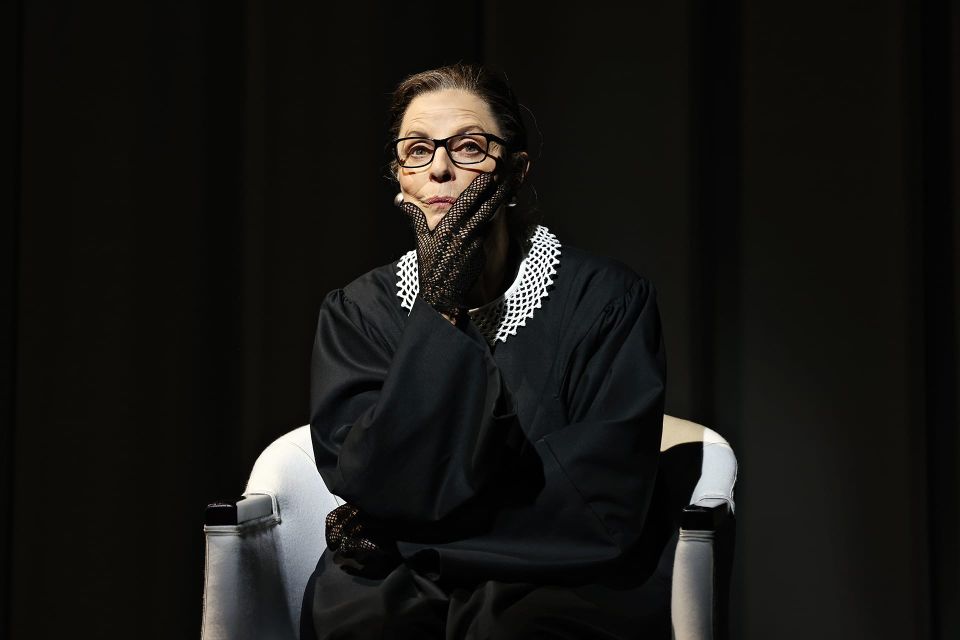
A response RBG: Of Many, One, presented by Auckland Theatre Company and Auckland Live in collaboration with Sydney Theatre Company, a play about the most internationally famous Supreme Court justice.
A diminutive woman stands in front of us, hair tied back, eyes seemingly magnified tenfold by her glasses, but utterly unyielding. That woman is Ruth Bader Ginsburg, or perhaps it’s RBG, as played by Heather Mitchell, and for the next hour-forty-five, the audience of RBG: Of Many, One (shortened to RBG hereafter), she is going to tell us about her life. We’re going to see her sitting by the phone, waiting to hear whether Bill Clinton will appoint her as the second ever female Justice on the Supreme Court. We’re going to see her win cases and set precedents for the rights of women. We’re going to see a facsimile of her workout routine, made famous after a Tumblr blog turned her into a meme.
RBG comes to the ASB Waterfront Theatre after premiering in Australia in 2022, eventually settling in for a season at Sydney Theatre Company, who take naming rights for this particular production’s presentation. Ruth Bader Ginsburg is the obvious pull for this show, but the show’s playwright, Suzie Miller, is the other pull, having written the hugely popular Prima Facie, the legal drama which spurred many a National Theatre Live subscription.
Miller runs us through Ginsburg’s life with little adherence to chronology. We open with her waiting for that phonecall from Clinton, we move back to her childhood, her difficulties being one of very few woman studying law at an Ivy League level at the time, we move forward to her talking with Obama. It’s a clever way of approaching the woman’s life, giving the sense that we’re getting a full picture even when we’re almost exclusively seeing snapshots in time. (The only bit that stands out as particularly inelegant, is Ginsburg’s lifelong appreciation of opera sparked in childhood, which seems to have been included mostly so that same music could be incorporated into the score.)
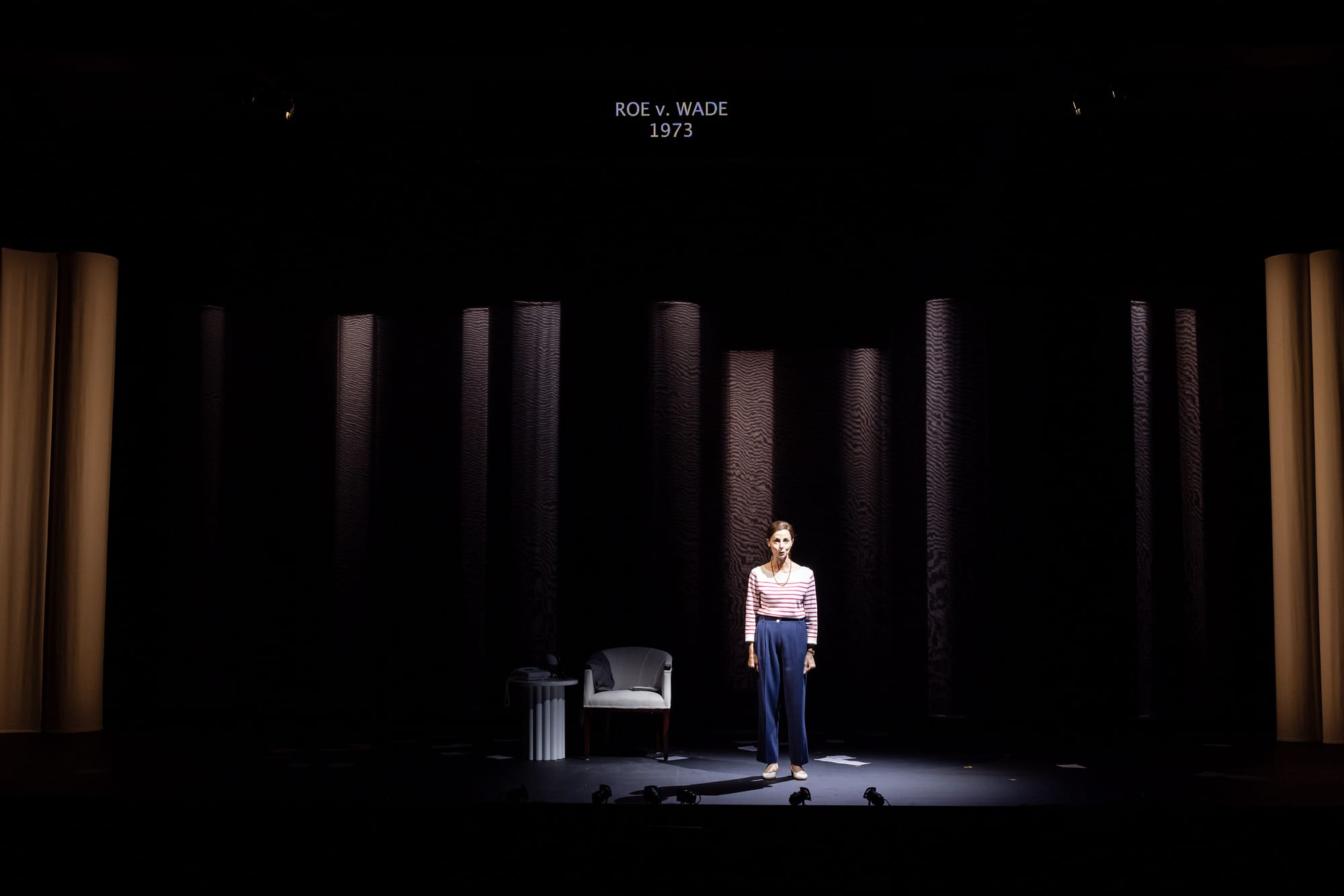
However, RBG sits inside a growing trend of theatrical work that takes familiar public figures and presents them to us in an easily digestible form. These shows have the same tropes. The public figure, usually played by an actor who resembles them in some way, either by fortunate genetics or considerable craft, will state their history, their viewpoints, and riff on their famous quotes in slightly inelegant ways. There will be jokes that reference a present day that the figure cannot possibly have any knowledge of, but they’ll make the audience laugh. These plays will often omit the more contradictory, conflicting, or straight-up problematic, parts of the public figure’s history so as not to disrupt prevailing narratives, and therefore the audience’s consumption of them. When these plays make it to production, they might have a few high-budget tricks to elevate them, and sadly RBG is a bit of an outlier here, despite some entertaining quick-changes, there are several long transitions involving the time-old tradition of people in blacks moving around the set in the dark, which I honestly haven’t seen in a mainstage production in some time.
The most popular example of this is probably Hamilton, which is obviously different for many other (musical) reasons. These shows include the likes of The Audience, The Lehman Trilogy, Six, and so on and so forth. RBG fits very much into this genre of play, perhaps standing out because it is a one woman show, told very much from the point of view of that woman. But in every other way? It’s unfortunately the same.
Many of the people coming into this play will be aware of Ginsburg’s feminism, even if not the specific life that she intertwined with that feminism. Those same people would not leave the show with much more education about the woman, the legal mind or even the specific conflicts she faced along the way, and indeed, where the show gets most granular and in-depth are the years that are well within living memory.
We do come away, however, well aware of Ginsburg’s feminism, and even the specific wave of feminism she belonged to (second, naturally). We come away with an understanding of her philosophy around the law and its importance to society. We come away with a knowledge of her love for her husband. These are important building blocks to us understanding her, and why she is the way she is, but they’re Duplo, not Lego, because there’s not a whole lot we learn about Ginsburg beyond all of this though, and it’s part of the worrying trend of plays like these. They end up being both a 101, and the final word.
After all, you’ve spent well over an hour and a half learning about Ginsburg’s life, you would assume that you’ve been afforded an insight into much of her complexities. Unfortunately, Miller’s script is extremely tunnel visioned – her Ginsburg is a woman in a man’s world, a rare legal mind who did great things for women – and her politics outside of this are barely touched on, and definitely not interrogated. Ginsburg had some viewpoints that, through either a contemporary or a modern lens, would be considered deeply conservative. It’s not for me to say whether that invalidates the good she did, but it definitely complicates it, and that complication seems far more interesting, and human, to portray, than what RBG is providing us. (In this, RBG shares a curious similarity with ATC’s previous production, Helen Clark in Six Outfits, which similarly elided many of Clark’s political contradictions, and frankly, her politics, in favour of highlighting her gender struggles.)
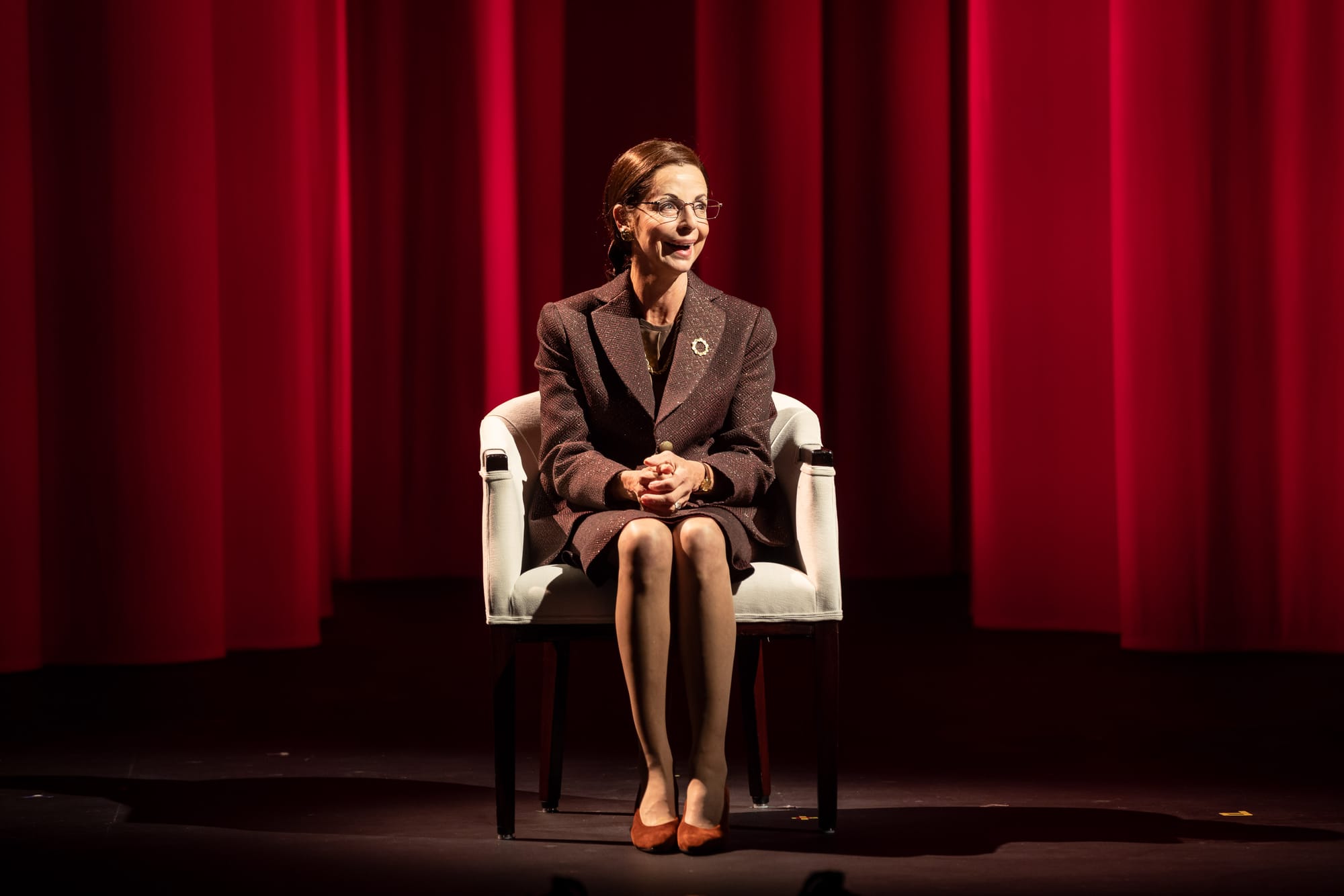
What RBG ends up being, then, is the continued lionisation, and even memefication, of a human being who was undoubtedly far more complex than the character presented to us – because all human beings are more complex than this. Whenever the play hints at interrogating the more intriguing contradictions in Ginsburg’s life, such as her friendship with the deeply Republican Antonin Scalia or her refusal to retire when urged to privately and publicly, they remain just hints. It simplifies the character even from the show’s initial pitch of “a great woman who did great things” to a two-dimensional, faux-inspirational image, as flat as the slogans posted on the merch that seemed to calcify her legacy in her later years.
What prevents the show from being entirely this is undoubtedly Mitchell, who gives the kind of performance you’d imagine whoever first came up with the phrase "virtuosic performance” was thinking of when they wrote it. It’s a feat of craft, specificity and endurance, and Mitchell captures the physicality and imagery of RBG that most of us would be familiar with – as an older woman during the Clinton and Obama administrations – without overdoing it. The most impressive thing Mitchell does, other than getting through over 90 minutes of a solo show, is progressing RBG’s ageing with such clarity that you could almost pinpoint the year she was showing us without the surtitles reminding us when we’re seeing what we’re seeing. She also, winningly, cannily, gives us a sense of RBG’s stubbornness, which could be interpreted as belligerence; she absolutely conveys the way that a human’s surety can quite easily be flipped to be inflexibility, and the stakes of that inflexibility when that human is in a place of power.
What purpose does RBG serve on the other side of the world? If it’s to educate us, an audience in a country touched more by the weight of Ginsburg’s impact than her individual actions, it’s a cursory, surface-level glance at a human who could serve as the subject of a three hour epic and still not be adequately reckoned with. If it’s to move us, it’s an intermittent success, thanks largely to Mitchell’s tremendous performance and our knowledge of the injustices that Ginsburg went up against as a woman in a man’s world. If it’s to enshrine Ginsburg’s legacy, to remind us of what she did, single-mindedly if not single-handedly, and how easily progress can be rolled back, it’s an undoubted success at enshrining a legacy.
I’m just not sure how honest, or how deep, RBG can be when it can’t even bring itself to acknowledge uncomfortable truths, let alone confront them. The most honest thing about the show ends up being the title; this isn’t a show about Ruth Bader Ginsburg, born March 15, 1933, who served for 27 years on the Supreme Court. No, this is a show about RBG, born 2013 on Tumblr, a list of achievements easily digested and understood, then put aside after the curtain call.
RBG: Of Many, One runs until June 7 at the ASB Waterfront Theatre.
This review was commissioned by Auckland Theatre Company. You can find more information about this commissioning structure here.


Member discussion