Critical Corner: Pork and Poll Taxes
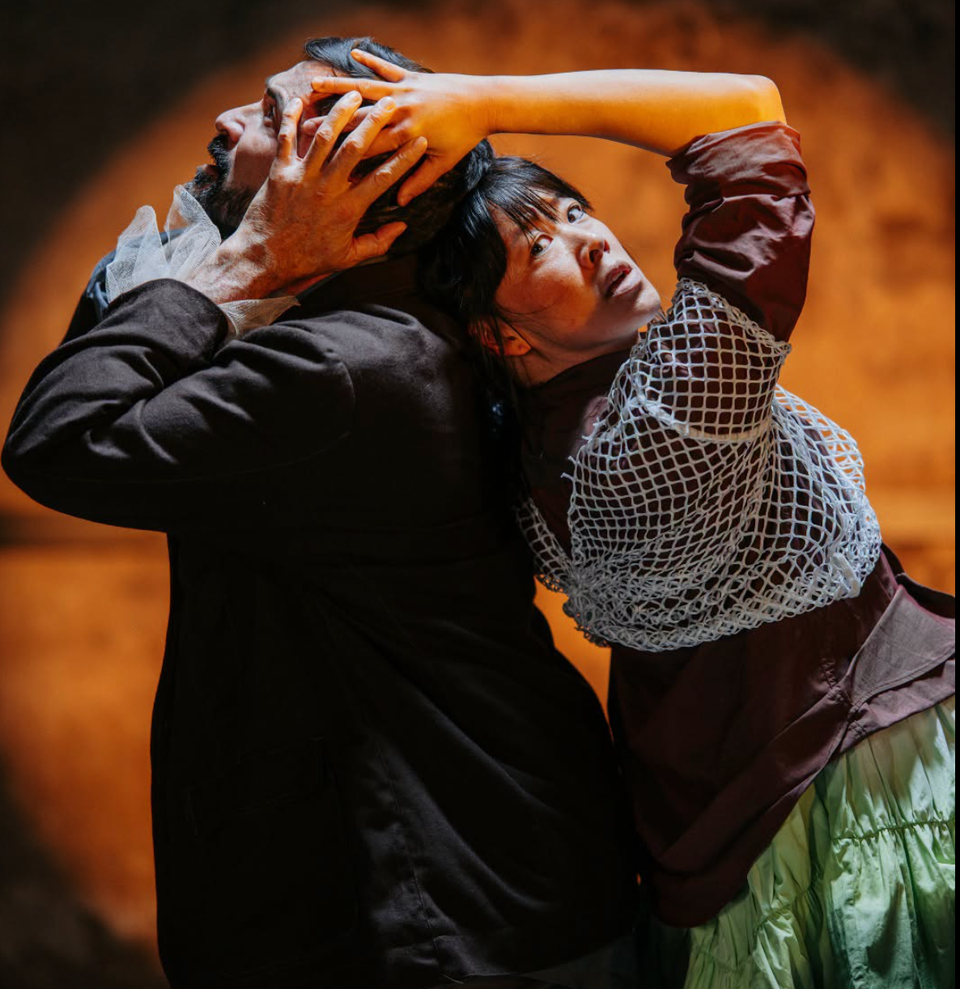
In this edition of Critical Corner, a review of Pork and Poll Taxes.
Pork and Poll Taxes, written by Talia Pua and directed by Chye-Ling Huang, is a lot of play. I mean this as the biggest compliment. Pua’s work comes to Herald Theatre, in a co-production between Proudly Asian Theatre, Hand Pulled Collective and Auckland Live after a development season in 2021. It tells the saga of a family who finds their lives changed by the entirely arbitrary – and wholly racist – poll tax imposed on Chinese immigrants that changes the trajectory of an entire ancestral line. One man, Jiu Choy, travels to Aotearoa to make a better life for his family, and instead traps them into something else entirely. The play skips back and forth across several years as the impacts of this seemingly innocent and maybe noble choice reverberate across generations.
Talia Pua – who also acts brilliantly in the show as the youngest link in this particular generational chain – has crafted a gorgeous play here. I could watch it for three hours. It is so incredibly difficult to write a play where everybody does what they do out of love, but nearly everything they do is also a source of harm. She also acutely captures the trap of what it is to do “the right thing” to assimilate and still be punished for it. This is a family drama of the highest echelon, and should be celebrated as such. There is a monologue delivered by Xiao Hu, playing the matriarch Ah Ma, that ranks amongst one of the best I’ve seen on Aotearoa stages in some time.
It’s the women in this play who are doing the heavy lifting. Xiao Hu serves as the spine of the show, and gives as brilliant a performance as I’ve seen in ages; a big play requires big choices and she makes them. As the playwright, Talia Pua knows her own music, performs it to the hilt, and reaches the heights that her character, betrothed and taken to the unfortunate end of that betrothal by the end, needs to. Nikita Tu Bryant pulls out reams and reams of subtext from her character, stuck between these two generations, and her attempts to do right by the person she needs to do right by the most towards the end of the play are heartwrenching.
The male cast fare less well, and it may be a chemistry issue. They are absolutely believable as the characters they play – Darren Young as the father who put this entire tragedy into play, and Dennis Zhang as his son who doesn’t quite know what he’s doing but knows he has to do it – but the musicality of those scenes falters a little bit. I understand them as mates, but not as father and son, two people who feel acutely aware of how they may succeed or fail each other. The weight is in the text, but not in the delivery. The play also gravitates towards the women more than it does the men, even as it’s the men who drive the plot – and so they also end up falling into relief quite a few times.
There are some genius choices in this production. To have Pākehā represented by uncannily masked people is perfect, and the masks themselves are fluid and unknowable; we feel as gross about them as the characters rightfully do. The seemingly unclimbable poplar trees to stage right serve not just as metaphor but canvas. A seed blooms into something that we invest in as much as the characters. Certain images – a veil falling on a girl who would rather set that same veil alight, children playing amongst the trees, a chain letter interpreted, white male politicians as spectres not humans – are what we go to the theatre for. This is nothing masquerading as theatre, this is proper theatre.
However, the production feels at odds with the play at crucial points, and it’s difficult to tell whether it is the play straining at the production or the production confining the play. As written, this feels like a play that needs a cast of at least a dozen – I blame only economics, never artists here – but the unfortunate end result of this is that we often see bodies who should be tragically wrestled apart by meaningless conditions talking to each other in the very next scene. The audience can imagine around that device, this is certainly neither the first nor the last play to involve doubling, but across the play’s nearly two hours it chips away at how we view these five performers in relation to each other – especially when the entire premise of the play is that a husband is working to bring his wife over to Aotearoa despite a crooked, racist, corrupt policy. It means less when that husband is casually chatting to that same human in the next scene where he grieves the probability of that.
Unfortunately, there are also at least three cataclysmic turning points in Pork and Poll Taxes where almost every element in the production clashes: the actors are nearly inaudible under the sound design, those same actors are severely underlit, the choreography is percussive without us being able to hear the percussion, and the projection feels glitched by those same actor’s physical presence in the space. Within the context of a play that is jumping across time and space, and counts those jumps as crucial to its construction, it feels like the audience is straining for information rather than being able to receive – and meaningfully engage – with it. It is hard to hear the story, the play, the characters, under all of it.
In that vein, Pork and Poll Taxes also struggles with clarity. Sometimes this is within scenes – it takes quite a bit of time to establish everyone’s relationship to each other, especially given that people are playing different characters at different points in time, the play is moving us back and forth across those same points, and our understanding of revelations is crucial to our engagement with the story. That lack of clarity also exists sometimes within the production as a whole, as it jarringly introduces core storytelling techniques almost a third of the way in (the aforementioned mask work, the metaphor of the seed). Part of this may be inherent to Pua’s script, but when the production settles and lets the actors act, lets the writing talk, it speaks loud, clear and profoundly. You feel the urgency of the text in these moments. You feel the necessity of it.
I can see the play that Pork and Poll Taxes is. I can see the importance and the worthiness, although no work of art should be burdened by either of those things. It will resonate and it will hurt. I can also see the play in the production. I can see it in the actors, I can see it in some of the design. It’s a bit obscured, a bit glitched, a bit distorted. As I said, it’s a lot of play, but it’s absolutely all there, and it’s worth it.
Pork and Poll Taxes runs at Herald Theatre until September 19.
Other Stuff I’ve Consumed
- Oceania’s Eleven is on at Basement Theatre until Saturday! I loved it. It's perfect spy-screwball comedy-vibes. Vincent Andrew-Scammell is one of my favourite performers in the whole country – I believe it is sold out tonight but if you're in Tāmaki Makaurau on Saturday there might be tickets left!
- Helena Gao's EP is giving me life. Exactly the pop I need in this over-exerted life.
Self-Promo
- I'll do better promo for this soon but I'm doing a show at Q Theatre in November called All You Had Was Fun. Book away!
As always, reading and writing takes time, and if you want to support the amount of time it takes (and ensure that the scant amount of meaningful coverage of local art can continue), please considering supporting Dramatic Pause with a paid subscription ($8 p/m, $60 p/a) and if you can't afford a paid subscription, please share the work with your networks!
Member discussion