Critical Corner: The Pearl Fishers

In this edition of Critical Corner, a review of NZ Opera's production of The Pearl Fishers.
You might have heard of Bizet but you haven't heard of The Pearl Fishers. You know Carmen, or at least the concept of. There's a real opportunity in exhuming the lesser known work of a brilliant composer, and an audience can find sounds and nuances to click into even if it doesn't necessarily reach the brilliance of their most well known work. I'm no scholar of opera, as any review I've written about it will transmit, but I would wager to guess that nobody would suggest that The Pearl Fishers is a more robust work than Carmen. But the repertoire of opera – as with any artform with hundreds of years worth of canon – is vast. If we only did the classics, we'd be left with a narrow, shallow canvas to engage with.
Which brings us to The Pearl Fishers, which revolves around a love triangle. Two men, Zurga (Samuel Dundas) and Nadir (Filipe Manu), fall in love with the same woman, Leïla (Madison Nonoa), who is also devoted to be a priestess (which this production warps, to varying success). As this is an opera that is in no way funny, and in no way intending to be so, things do not go to plan.
New Zealand Opera's production relocates the concept from Sri Lanka (wisely so, given the racist overtones of the core text) to a vaguely French-seeming resort. All three principles are still people of colour, as are many of the chorus, but the exoticism is thankfully extracted from the text. However, the actual concept of the show feels pretty loose – it is a resort, or a retreat – it feels less The White Lotus and more Nine Perfect Strangers, and the role of the chorus, a blend of staff, guests, and bodyguards is even looser.
After a video introduction that feels like AI even if it is not AI (an unfortunate pitfall that artists from every vein are going to encounter sooner than later), we're presented with the resort/retreat that serves as the setting of the show. The structure of the show means that a lot of time is spent building up the community that will eventually encroach upon this love triangle, but that specific community is drawn with such basic strokes that it never feels securely defined. Why do the staff of this retreat care about these three people? Why do the guests? Why do the militarised bodyguards care? I would presume it's because the original show consisted of a consolidated community who relied on each other, and specific services of the triumvirate at the centre of the show for their livelihood, but in this production, it feels extremely petty, and also, extremely low-stakes.
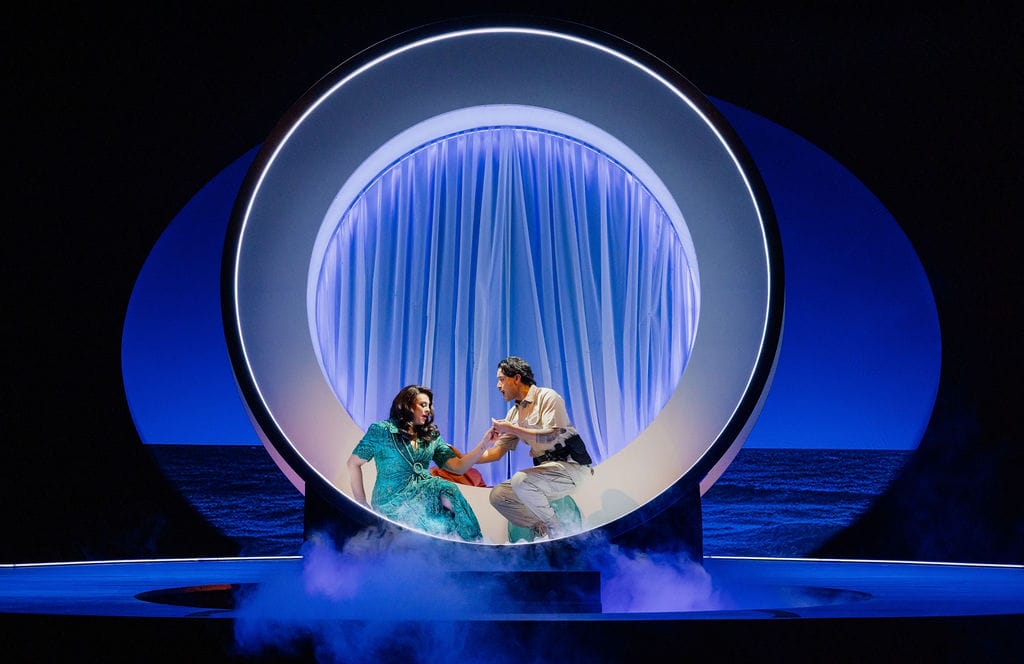
That's, frankly, an issue with this production. It is so consistently sedate, which feels strange for such a dramatic show. This isn't a fault of the music, or the performers, but the concept, which feels so built for a screen rather than a a stage – let alone a stage of this size. Nobody goes to opera to see the literal, to see the real, to see the natural. This is music to be performed by people whose craft is beyond that same natural. It feels paradoxical, even cruel, to bind them to natural movements, realistic costumes, and realistic staging. The third act of the show is so clumsily blocked that it felt like a drama school show; two performers in tiny room rather than two performers in a space with over a thousand people in it. I say this as an occasional viewer of opera, a regular viewer of theatre, and a seasoned maker of that same form: all of those things are achieved at a fraction of the budget, and when you put all of those things in a form that demands size, and scale, it looks and feels cheap.
The surtitles were also a consistent issue, and sometimes felt far behind the text that is being performed for us, undercutting those same performers. Translation is never a 1:1 affair, but too often a core mechanism to understanding what was being performed felt wildly out of sync with what it was meant to communicate to the audience.
The second act of The Pearl Fishers is where it really thrives. The chorus recedes offstage, and Madison Nonoa is allowed to take centre stage. She is flat-out stunning, able to project complexities to the back row while adhering to the production's naturalism. She is magnetic enough to draw the second act's design into her; it feels less like she is being lit and more like she is drawing the light to her. It takes a powerful performer to do that, and Nonoa brings the brighter, broader, more vibrant, colours to this production's interpretation of naturalism. When she felt, I felt. That should be a given with any artform, but so often this particular one is laden with design, and it might be a diamond in the rough type situation that nothing, ever, obscures Nonoa (not even a truly strange hat that feels more prop than costume).
I'm not sure what this version of The Pearl Fishers is trying to say. There's a strangely modern take on the relationship between the three principals that I'll keep thinking of; a weirdly dark friendship between two men who know they love the same woman but refuse to admit it, a woman who knows she loves one man but is under the thumb of the other, a community who wants to see somebody burn for whatever reason. The concept, as modern as it might be, does not feel fit for purpose, and the attempts at naturalism feel like turning down the dials on the drama rather than focussing in on them. But nothing can dim Nonoa, and perhaps nothing could. The Pearl Fishers may be a curio in the context of Bizet, but if it lets a performer like that shine? Platform a curio.
The Pearl Fishers runs at the Kiri Te Kawana in Auckland on September 23, September 25 and September 27, then at the Isaac Theatre Royal in Christchurch on October 14, 16, and 18.


Member discussion